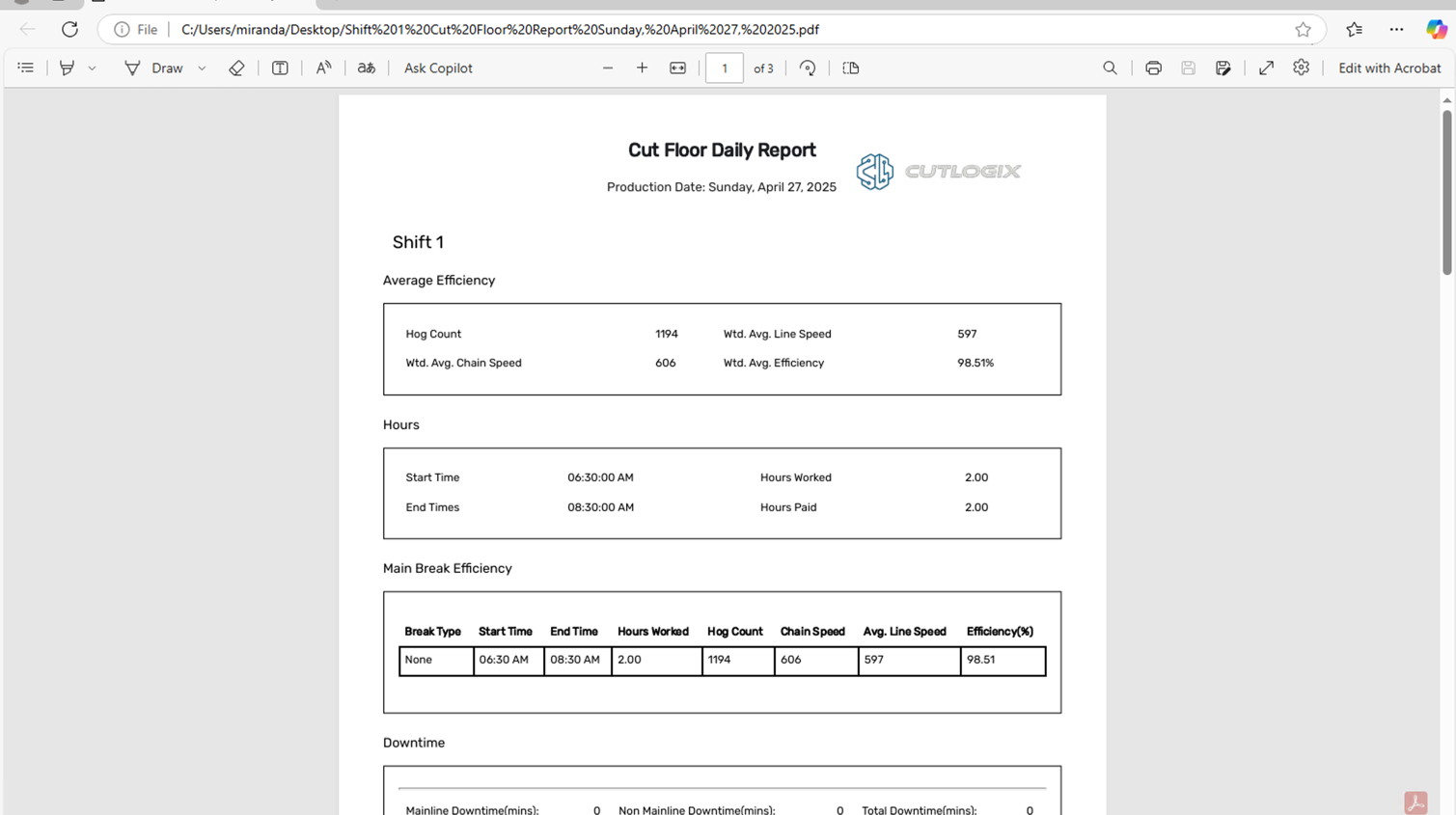
Daily Cut Floor Tasks
How to Add a Daily Cut Report
Demo
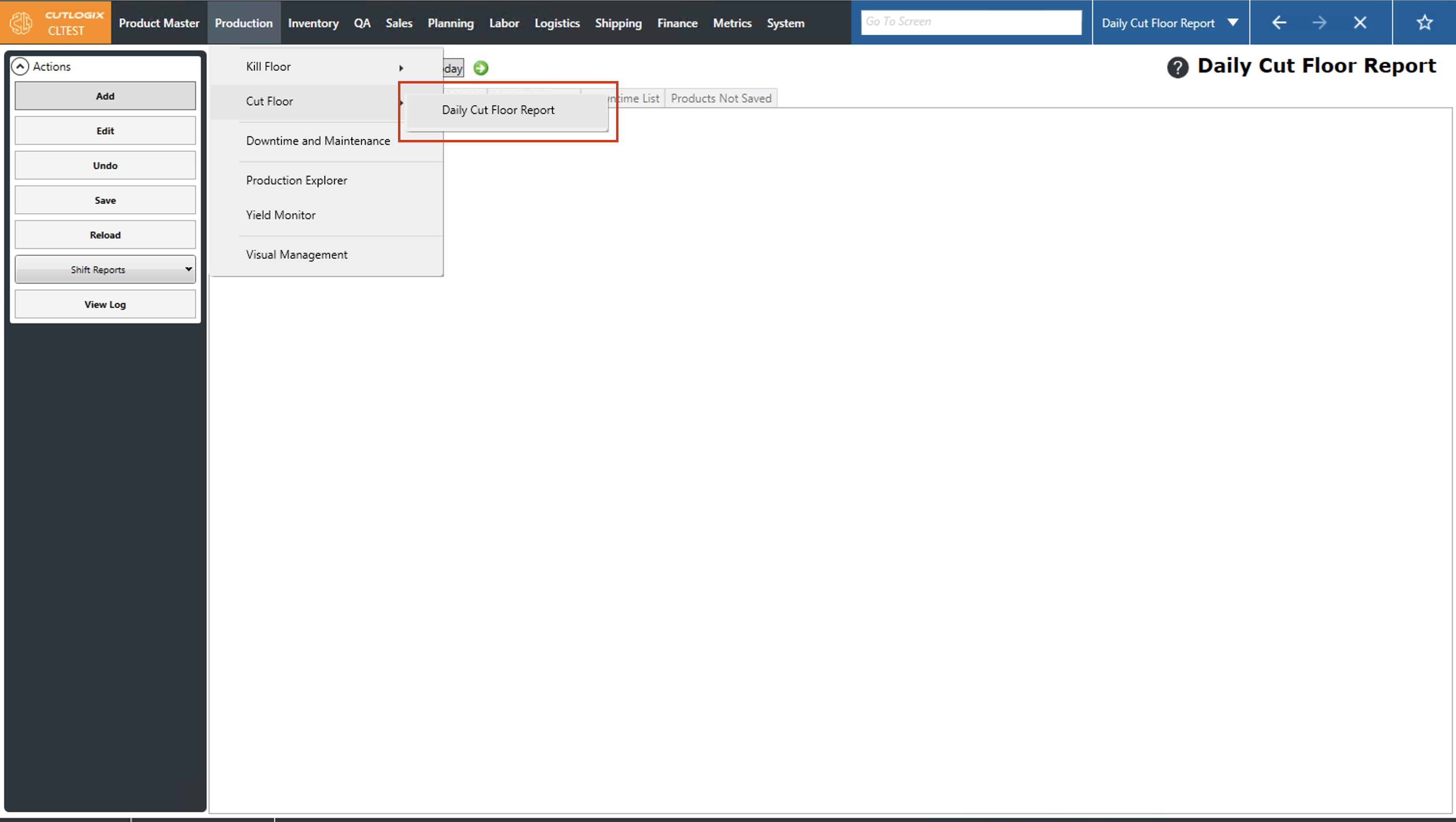
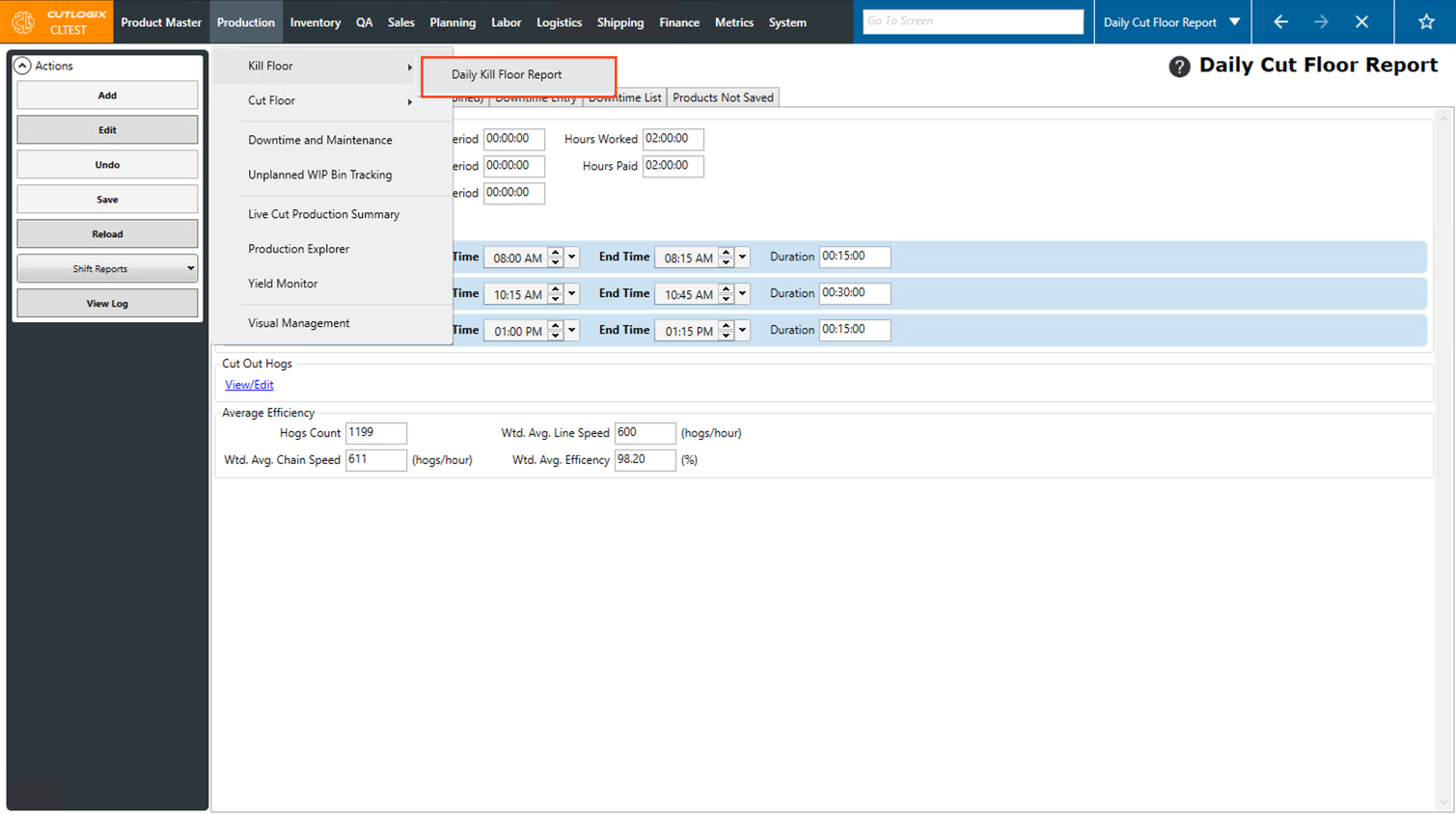
Step 1: Navigate to the "Daily Cut Floor Report" page (Under the Production menu → Cut Floor → Daily Cut Floor Report)
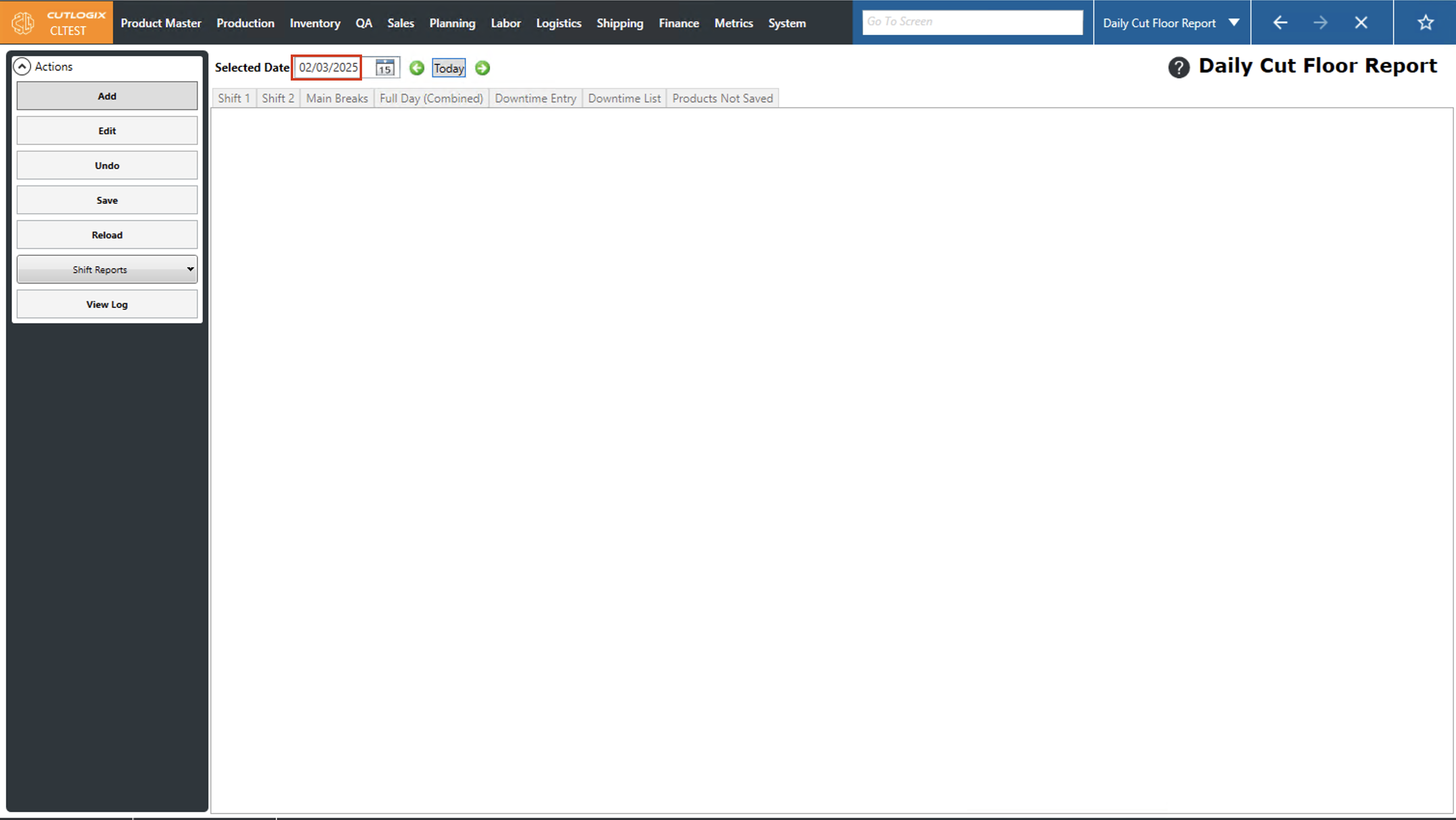
Step 2: Use the datepicker to select the date that you want to add a daily cut report for. Clicking the calendar icon will bring up the date picker to choose a date. By default, the current date will be selected.
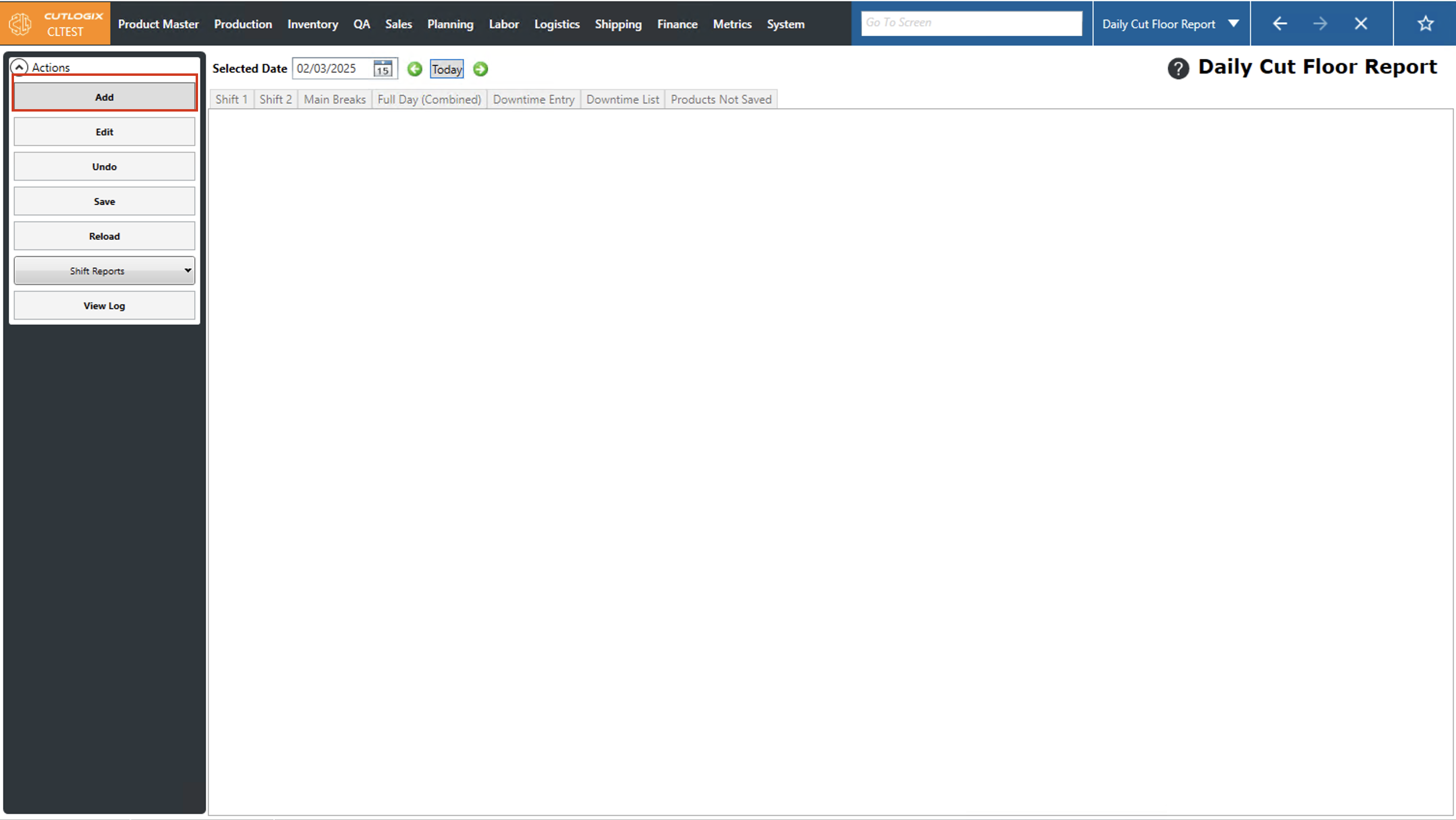
Step 3: To add a new report, click the "Add" button on the left side actions panel. The add button will only be clickable if there is not an existing daily kill report for the selected day.
Step 4: When adding the new daily cut report, a blank report template will open. There are several tabs on this report, many of the default data shown is pulled in from other areas of CutLogix (Ex. Shift times and breaks are pulled from Plant Config → Shift Configuration)
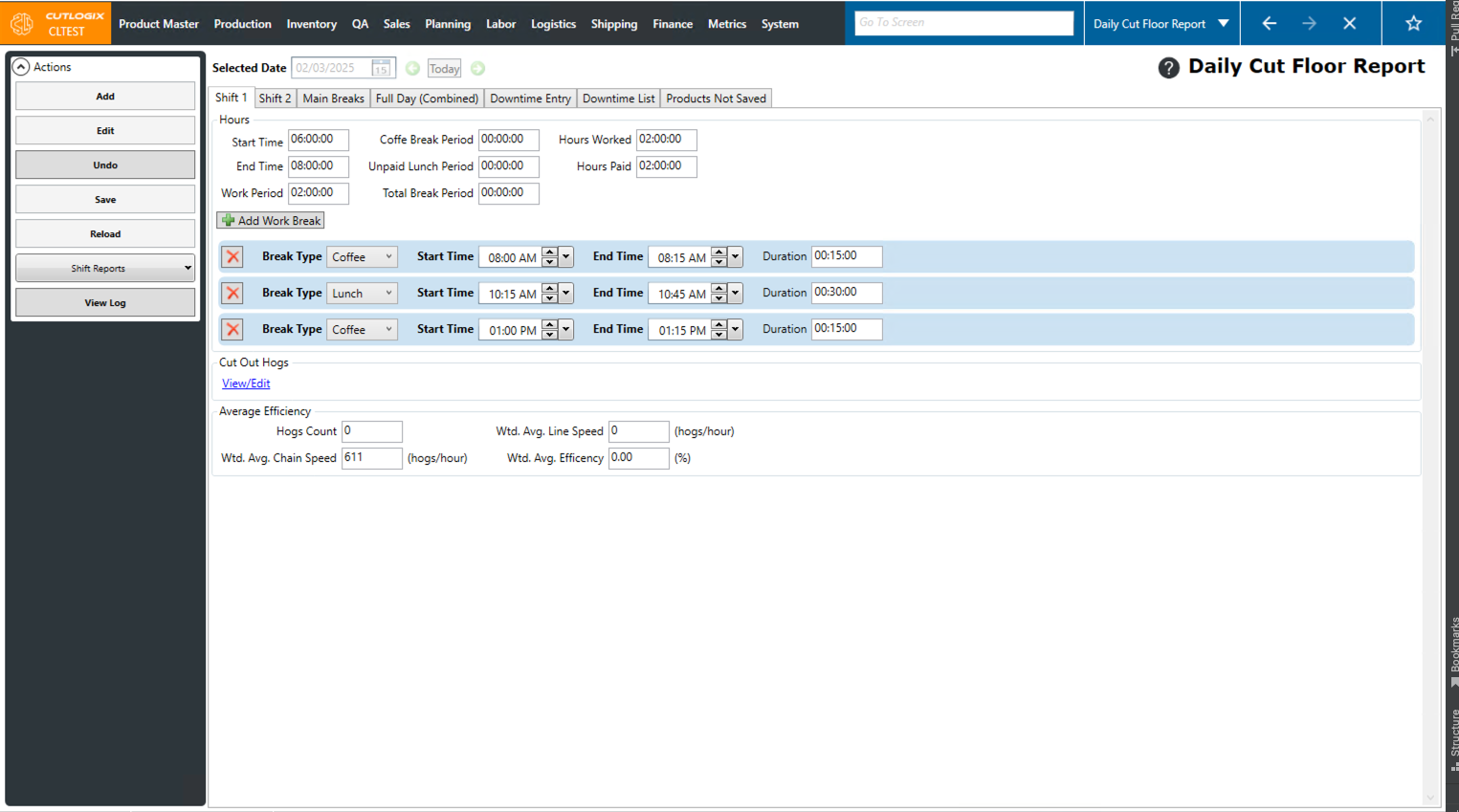
Step 5: The tabs available on this page are as follows:
• Shift 1: The details about shift 1, like hours, staffing and efficiency.
• Shift 2: The details about shift 2, like hours, staffing and efficiency.
• Main Breaks: The main break records for the selected day. NOTE: "Accum. Hog Count" is required and must be entered before the daily cut floor report can be saved.
• Full Day (Combined): This tab displays the combined details about shift 1 and 2 as well as breaks.
• Downtime Entry: Add/Edit and View downtime records for the selected date.
• Products Not Saved: Add/Edit and View products not saved records for the selected day.
• Shift 1: The details about shift 1, like hours, staffing and efficiency.
• Shift 2: The details about shift 2, like hours, staffing and efficiency.
• Main Breaks: The main break records for the selected day. NOTE: "Accum. Hog Count" is required and must be entered before the daily cut floor report can be saved.
• Full Day (Combined): This tab displays the combined details about shift 1 and 2 as well as breaks.
• Downtime Entry: Add/Edit and View downtime records for the selected date.
• Products Not Saved: Add/Edit and View products not saved records for the selected day.
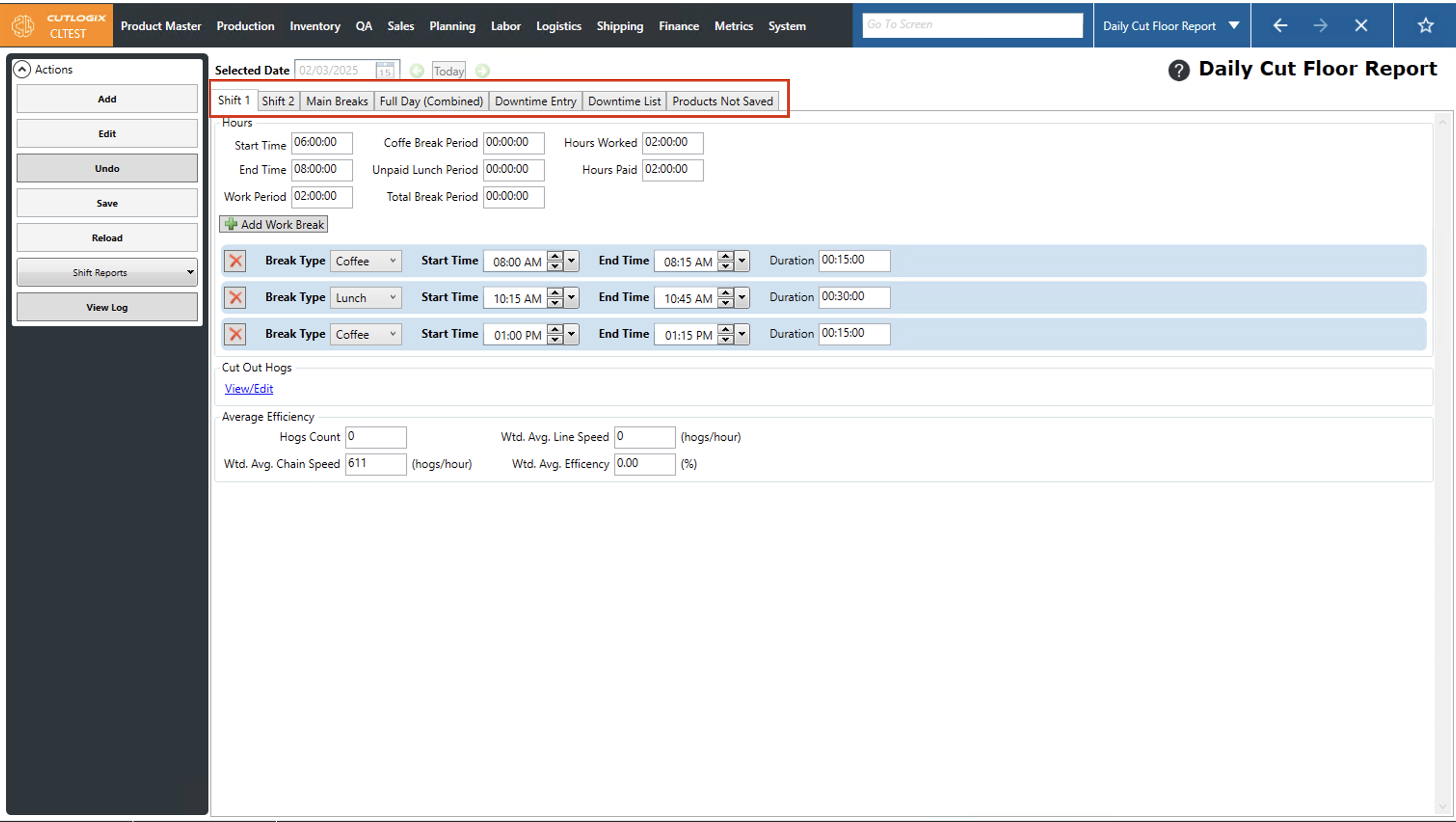
Step 6: Click "Save" in the Actions panel once all the necessary information has been added for the Daily Cut Floor Report. If you don't want to save the report, clicking "Undo" in the left actions panel will discard any changes.
How to Edit a Daily Cut Report
Demo
Step 1: Navigate to the "Daily Cut Floor Report" page (Under the Production menu → Cut Floor → Daily Cut Floor Report)
Step 2: Use the datepicker to select the date that you want to edit the daily cut report for. Clicking the calendar icon will bring up the date picker to choose a date. By default, the current date will be selected.
Step 3: Click the "Edit" button in the Actions Panel to enable editing for the daily cut report.

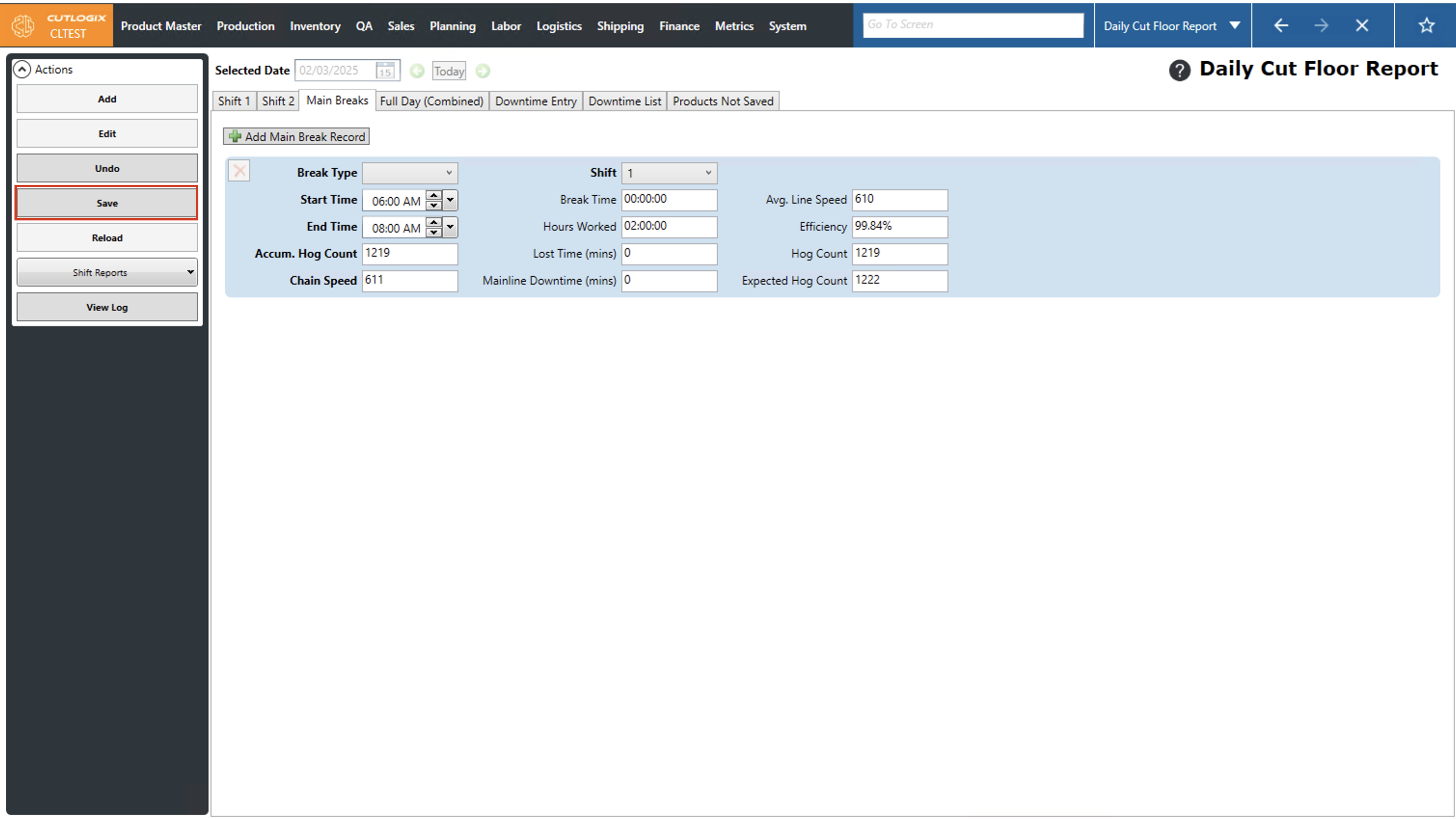
Step 4: The daily cut report will be populated with the data that has already been entered for it. You can make changes to the data in the following tabs: Shift 1, Shift 2, Main Breaks, Downtime Entry, and Products Not Saved.
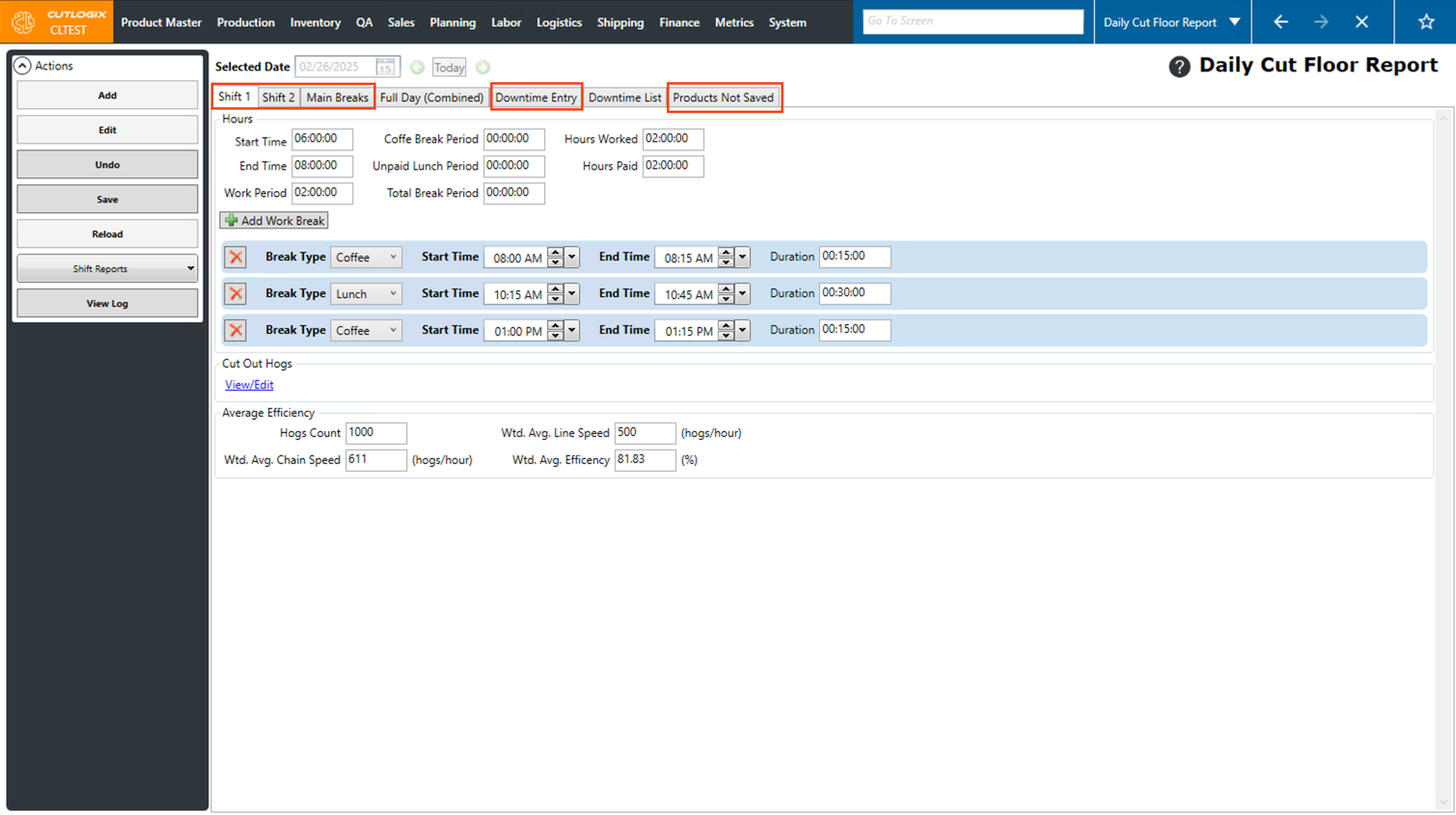
Step 5: Once you're finished making changes to the daily cut floor report, click "Save" in the Actions panel to save them. If you don't want to save changes to the report, clicking "Undo" in the left actions panel will discard any changes.
How to Navigate to Different Days on the Daily Cut Report
Demo
Step 1: Navigate to the "Daily Cut Floor Report" page (Under the Production menu → Cut Floor → Daily Cut Floor Report)
Step 2: When you first open the Daily Cut Floor Report it is set to the current date by default. This can be seen near the top left corner, beside the "Selected Date" title.
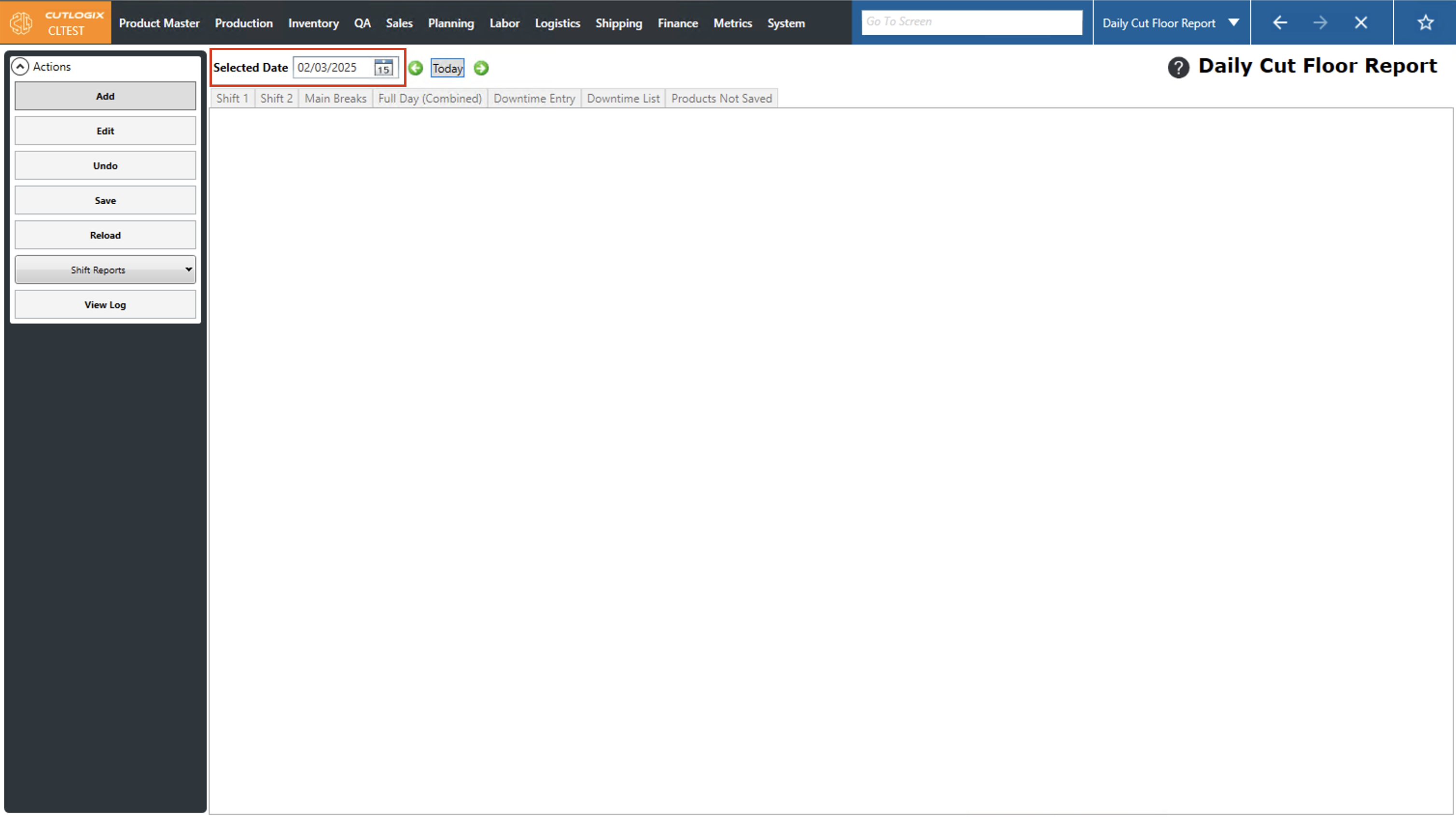
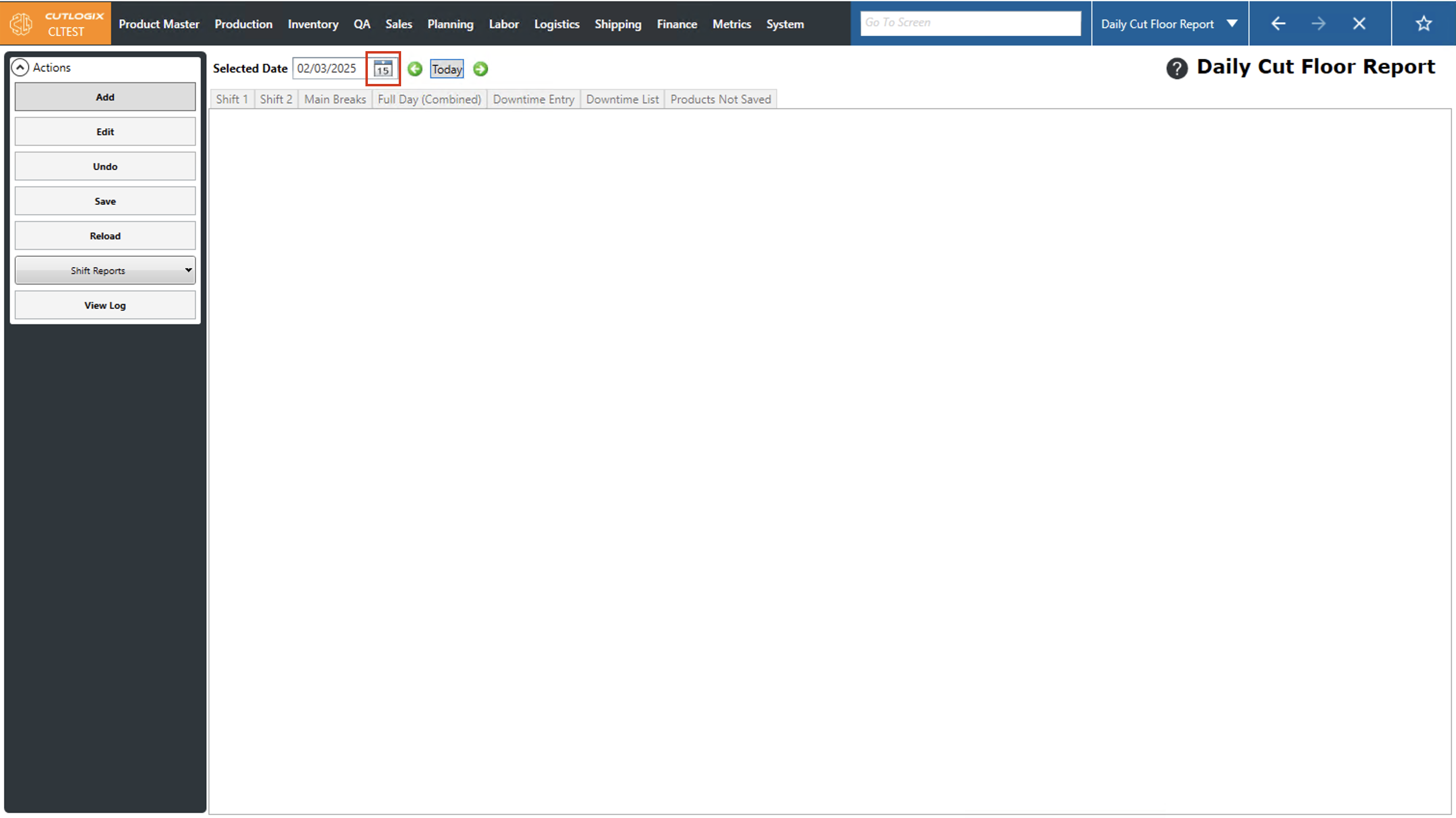
Step 3: If you want to view the Daily Cut Floor Report for a different day, you can click the calendar icon beside the selected date and choose a past date to view the report for. Once selected, the report will open with the data for the selected date.
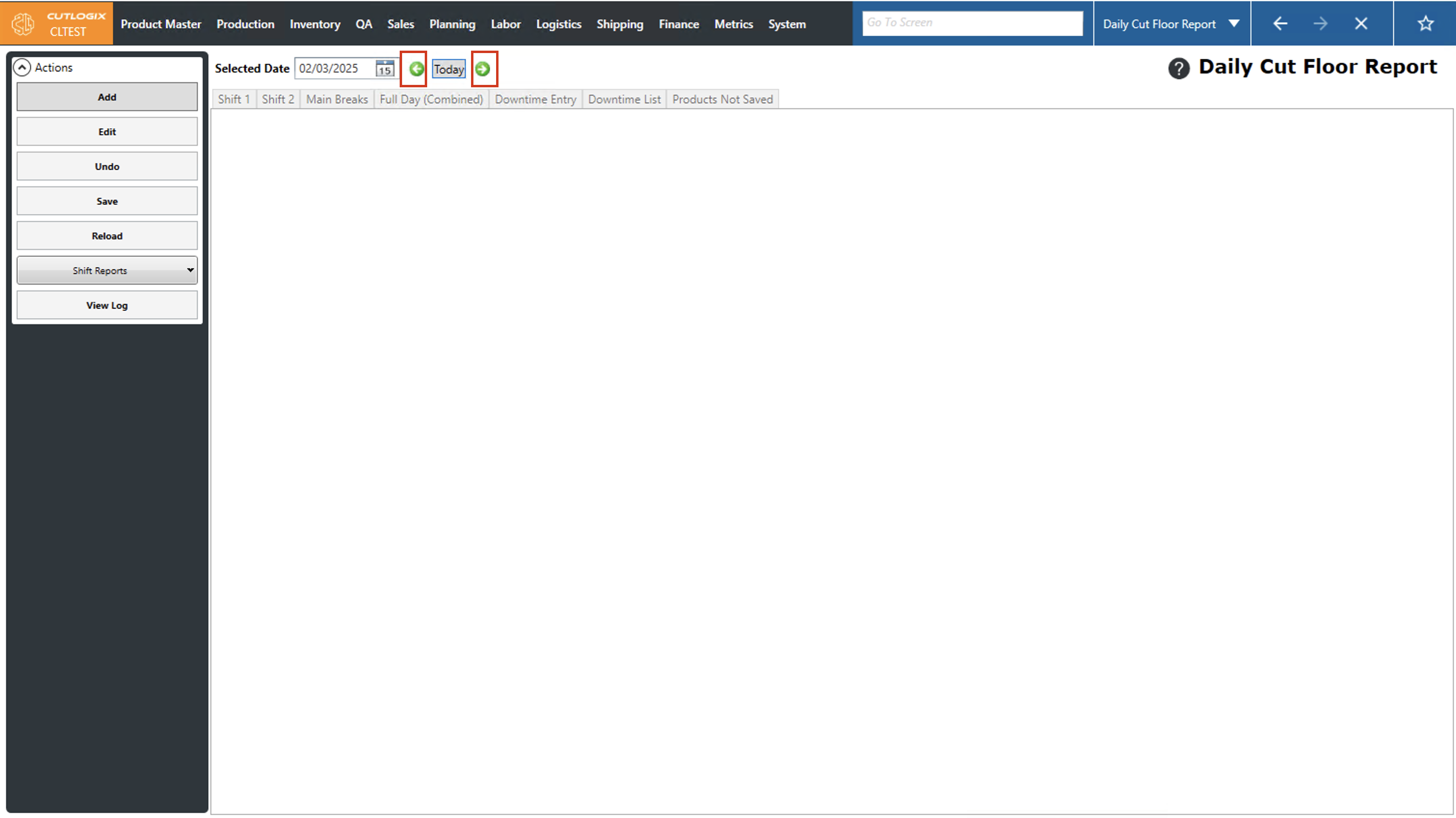
Step 4: You can also use the green arrows to navigate to different days. Clicking the arrow on the left side will navigate to the previous day and clicking the arrow on the right will navigate to the next day. Clicking the "Today" button (between the arrows) will take you to the current day.
Step 5: You can also manually enter a date in the "Selected Date" field to view the report for. The date must be entered in MM/DD/YYYY format. Once you've entered a date you can click out of the datepicker or click "Enter" on your keyboard and the report will open for the date that you entered (if one exists).
How to Add Main Break Records
Demo
Note: One main break record is created when the Daily Cut Floor Report is created. This guide outlines how to add additional main break records to the daily cut floor report.
Step 1: Open the "Daily Cut Floor Report" page, located under the Production menu → Cut Floor → Daily Cut Report.
Step 2 Use the datepicker to choose the day that you want to add a Main Break record to.
NOTE: The chosen day must already have a Daily Cut Floor Report created in order to create main break records.
NOTE: The chosen day must already have a Daily Cut Floor Report created in order to create main break records.
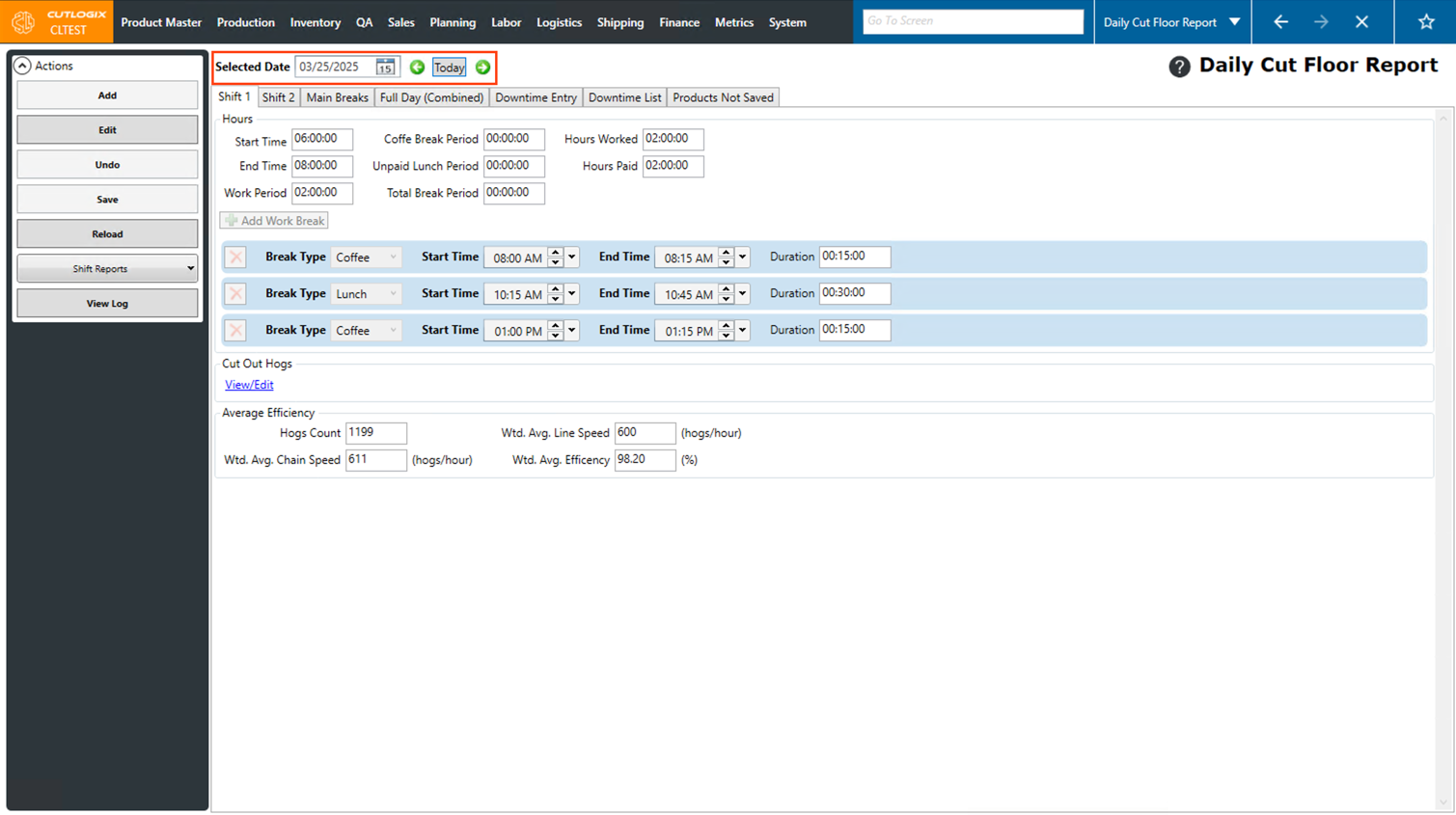
Step 3: Click on the "Main Breaks" tab, then click the "Edit" button in the Actions Panel.
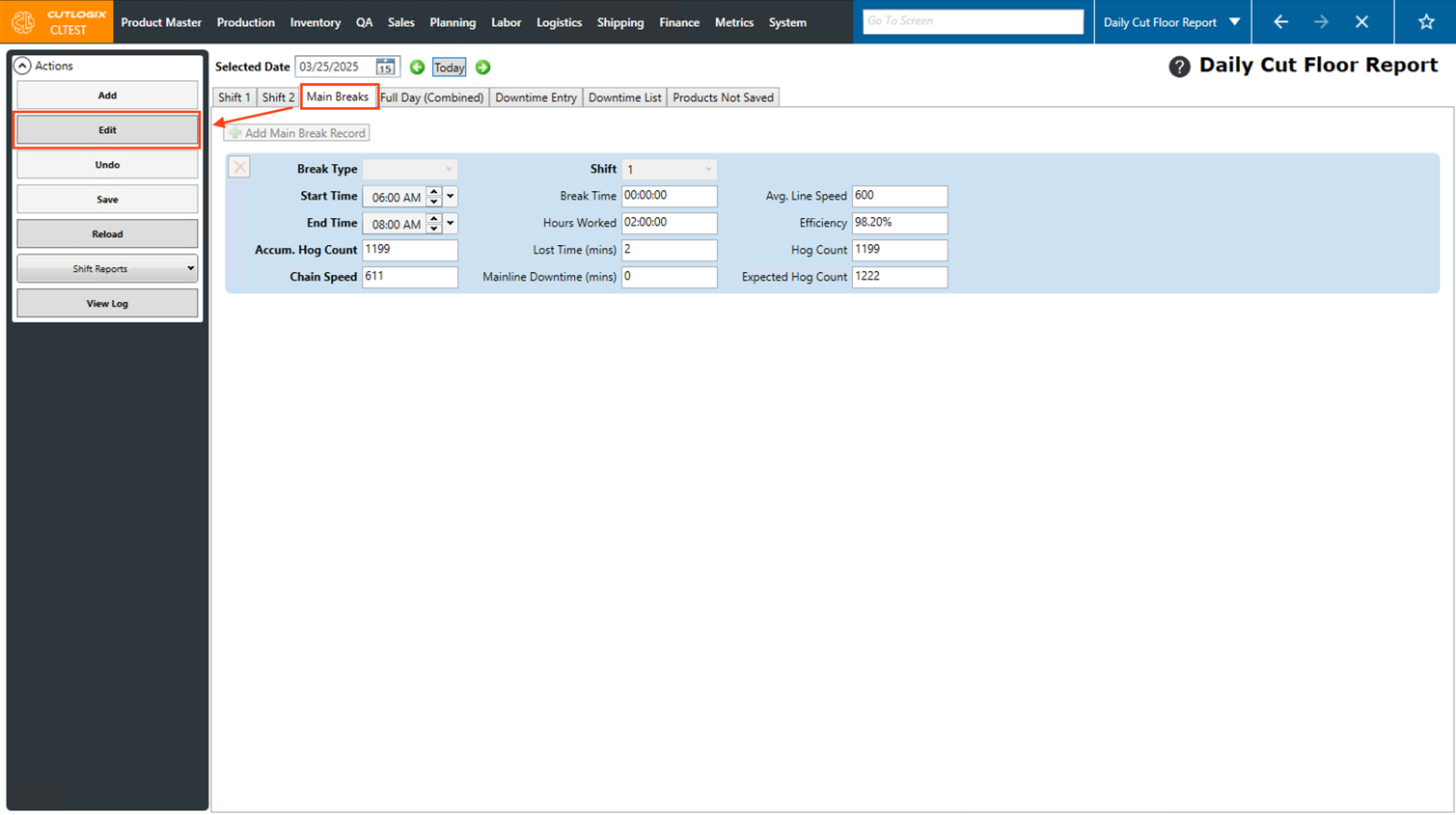
Step 4: Next, click on the "Add Main Break Record" button at the top of the page.
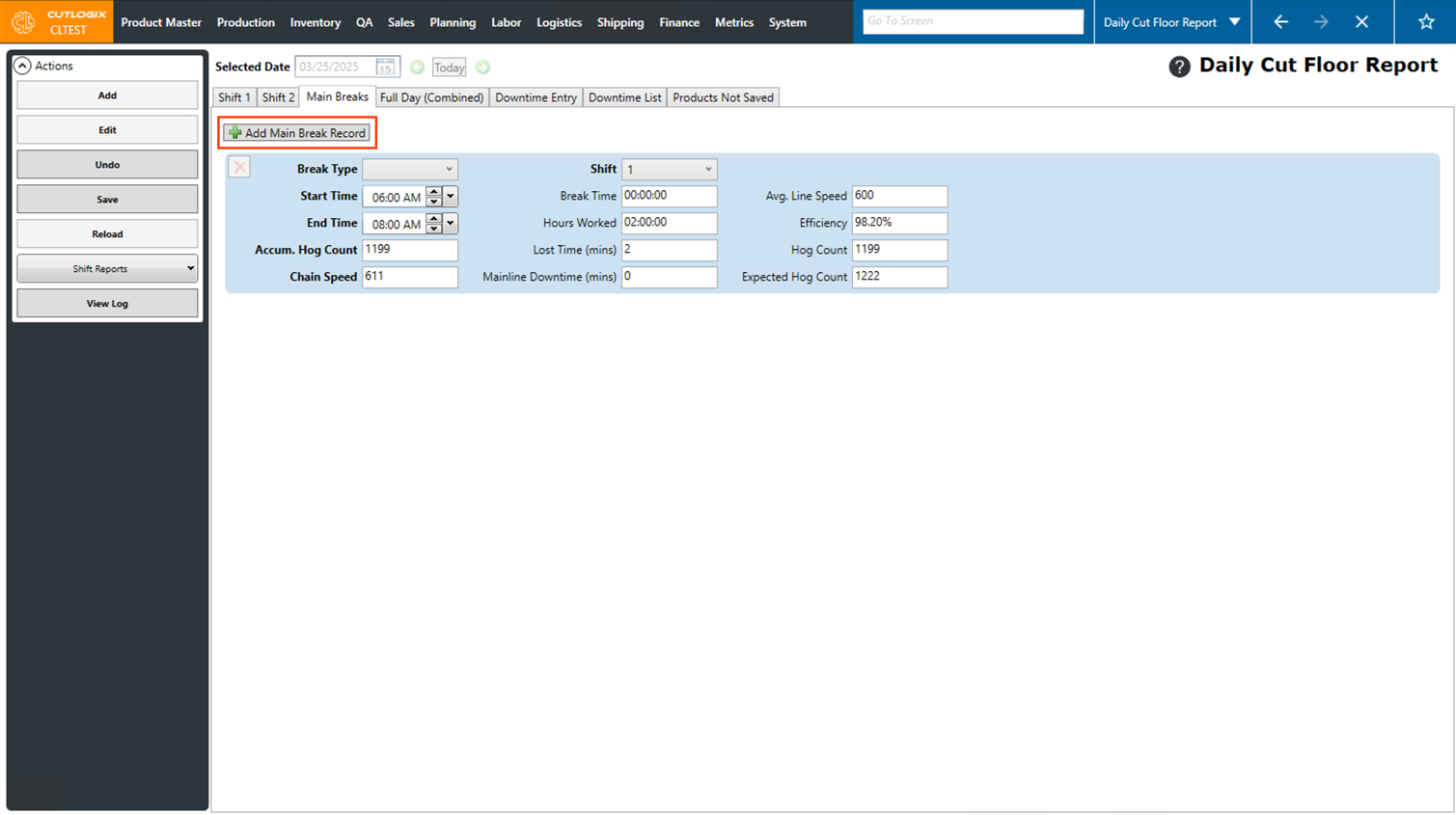
Step 5: A new main break record will appear, it will be partially populated from information in the shift configuration. On these records/blocks you can modify the fields that have bold titles, the remaining fields are calculated and cannot be manually modified. All the fields on a main break record are as follows:
• Break Type: The type of main break used for the main break record block. A main break refers to the vertebrae between which the hog is cut to separate the head and shoulder from the loin, belly and the ham.
• Start Time: The beginning time of the main break record block.
• End Time: The end time of the main break record block.
• Accum. Hog Count: The cumulative number of hogs processed over all time blocks up to this point.
• Chain Speed: How quickly hogs are moving through the cut floor, specified in hogs per hour.
• Shift: The shift that the main break record occurred on.
• Break Time: The duration of time within the main break record that was allocated to breaks.
• Hours Worked: The duration of time worked on the main break record. This is calculated as the difference between the start and end time, minus break time.
• Lost Time (mins): The amount of time, in minutes that were lost or running behind. This is calculated as the difference between the expected hog count and the hog count, divided by the chain speed, then multiplied by 60 to get the time in minutes.
• Mainline Downtime: The duration of time which the mainline was down during the selected main break record.
• Average Line Speed: The average number of hogs processed during this time block.
• Efficiency %: The calculated efficiency of the selected block. This is calculated as the average line speed (ALS) divided by the chain speed (CS).
• Hog Count: The total number of hogs processed on the time block.
• Expected Hog Count: The expected number of hogs to be processed in the time block. (Calculated based on the hours worked and the chain speed.)
• Break Type: The type of main break used for the main break record block. A main break refers to the vertebrae between which the hog is cut to separate the head and shoulder from the loin, belly and the ham.
• Start Time: The beginning time of the main break record block.
• End Time: The end time of the main break record block.
• Accum. Hog Count: The cumulative number of hogs processed over all time blocks up to this point.
• Chain Speed: How quickly hogs are moving through the cut floor, specified in hogs per hour.
• Shift: The shift that the main break record occurred on.
• Break Time: The duration of time within the main break record that was allocated to breaks.
• Hours Worked: The duration of time worked on the main break record. This is calculated as the difference between the start and end time, minus break time.
• Lost Time (mins): The amount of time, in minutes that were lost or running behind. This is calculated as the difference between the expected hog count and the hog count, divided by the chain speed, then multiplied by 60 to get the time in minutes.
• Mainline Downtime: The duration of time which the mainline was down during the selected main break record.
• Average Line Speed: The average number of hogs processed during this time block.
• Efficiency %: The calculated efficiency of the selected block. This is calculated as the average line speed (ALS) divided by the chain speed (CS).
• Hog Count: The total number of hogs processed on the time block.
• Expected Hog Count: The expected number of hogs to be processed in the time block. (Calculated based on the hours worked and the chain speed.)
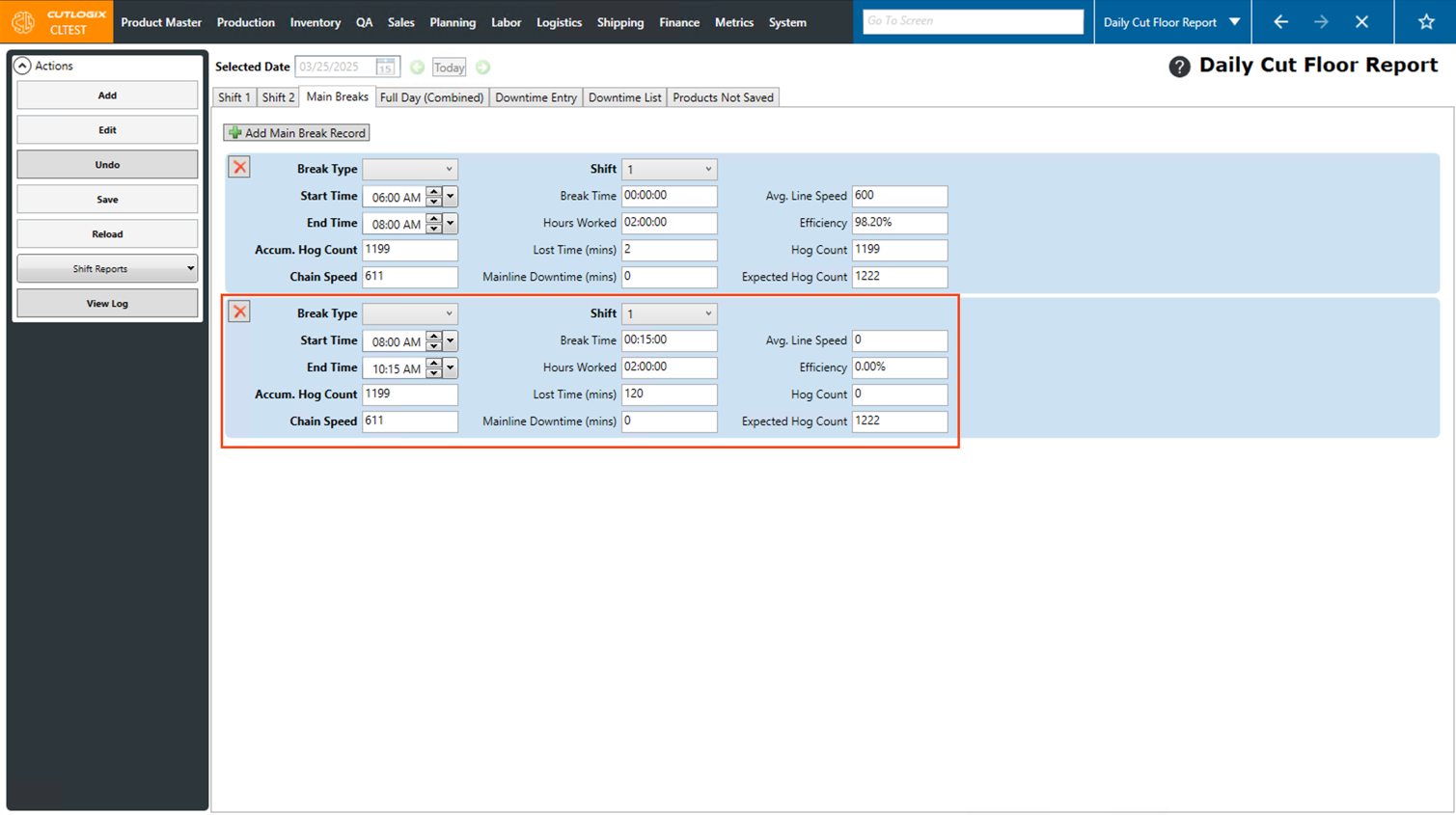
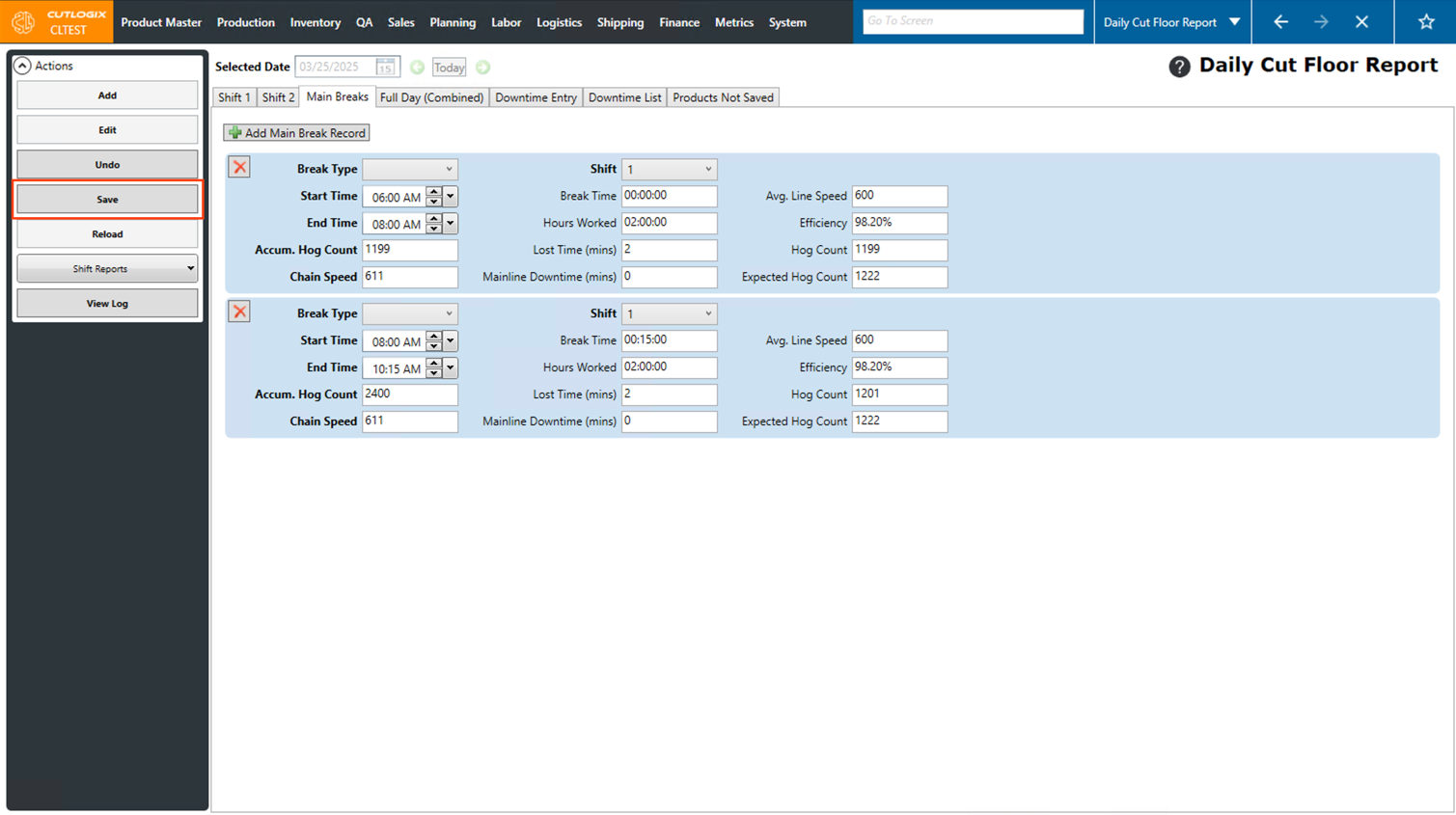
Step 6: Once you've filled out all the details about the main break record block, click the "Save" button in the Actions Panel to save it. If you don't want to save the new main break record, clicking "Undo" in the Actions Panel will discard it.
How to Edit Main Break Records
Demo
Step 1: Open the "Daily Cut Floor Report" page, located under the Production menu → Cut Floor → Daily Cut Report.
Step 2: Use the datepicker to choose the day that you want to add a Main Break record to.
NOTE: The chosen day must already have a Daily Cut Floor Report created in order to create main break records.
NOTE: The chosen day must already have a Daily Cut Floor Report created in order to create main break records.
Step 3: Click on the "Main Breaks" tab, then click the "Edit" button in the Actions Panel.
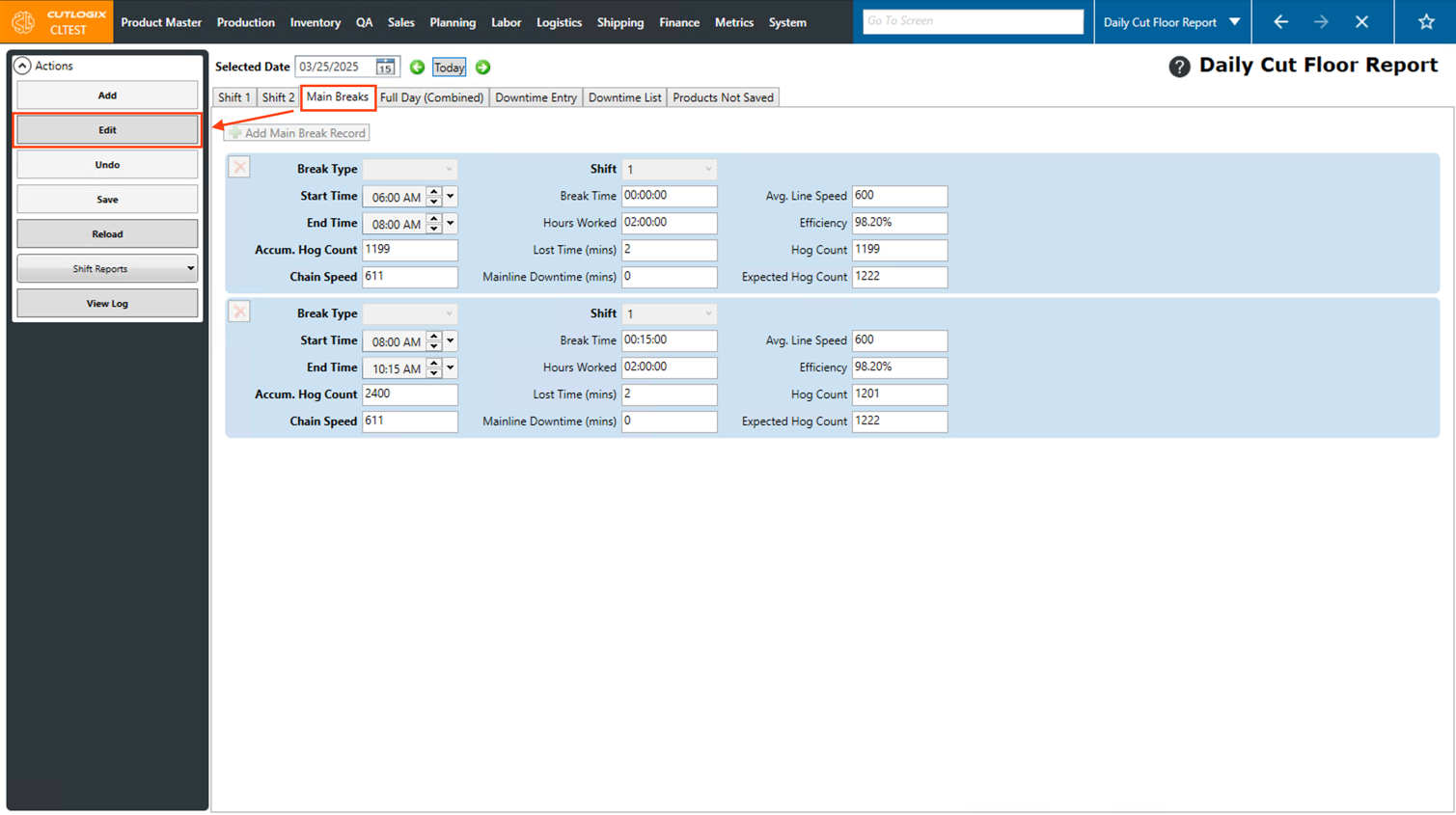
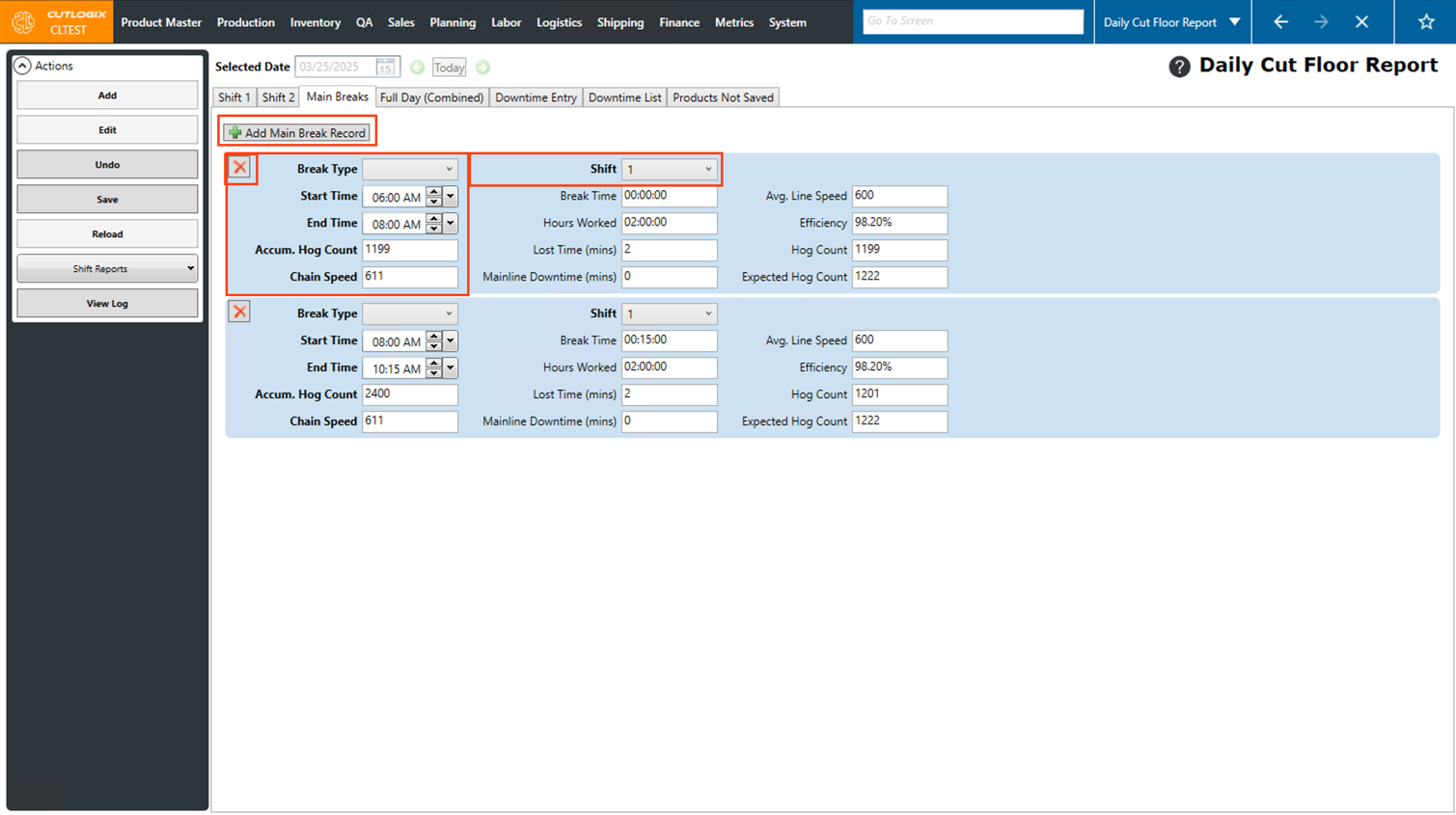
Step 4: Editing will now be enabled on the main break records. You can modify any information in fields with a bold title. You also have the option to add additional main break records by clicking the "Add Main Break Record" button at the top of the page, or delete existing main break records by clicking the "X" beside the ones you want to delete.
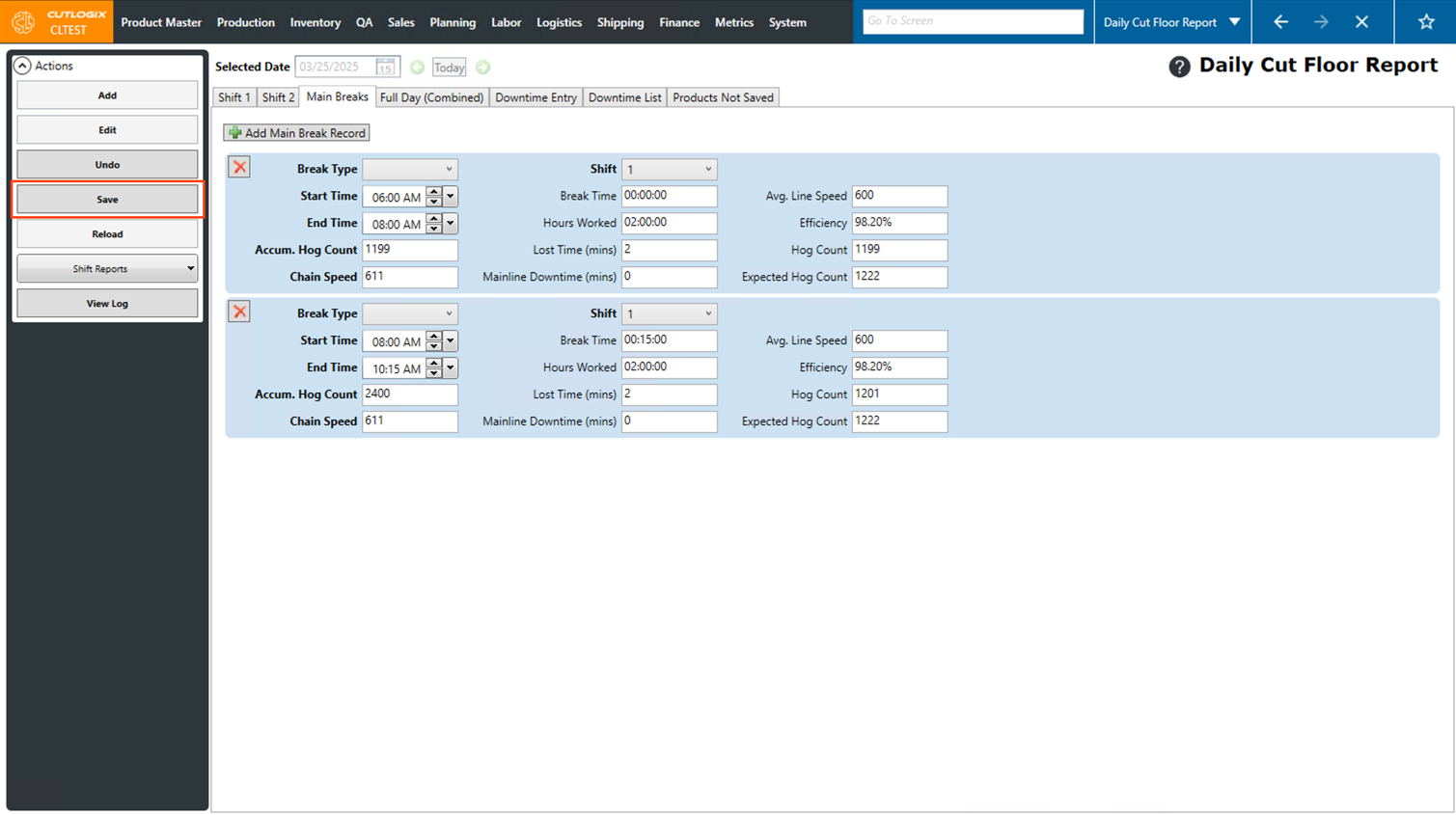
Step 5: Once you're finished making changes, click the "Save" button in the Actions Panel to save them. If you don't want to save your changes, clicking the "Undo" button in the Actions Panel will discard them.
How to Add Downtime Records
Demo
Step 1: Open the "Daily Cut Floor Report" page (Under the Production menu → Cut Floor → Daily Cut Report) for the date that you want to add a downtime record for.
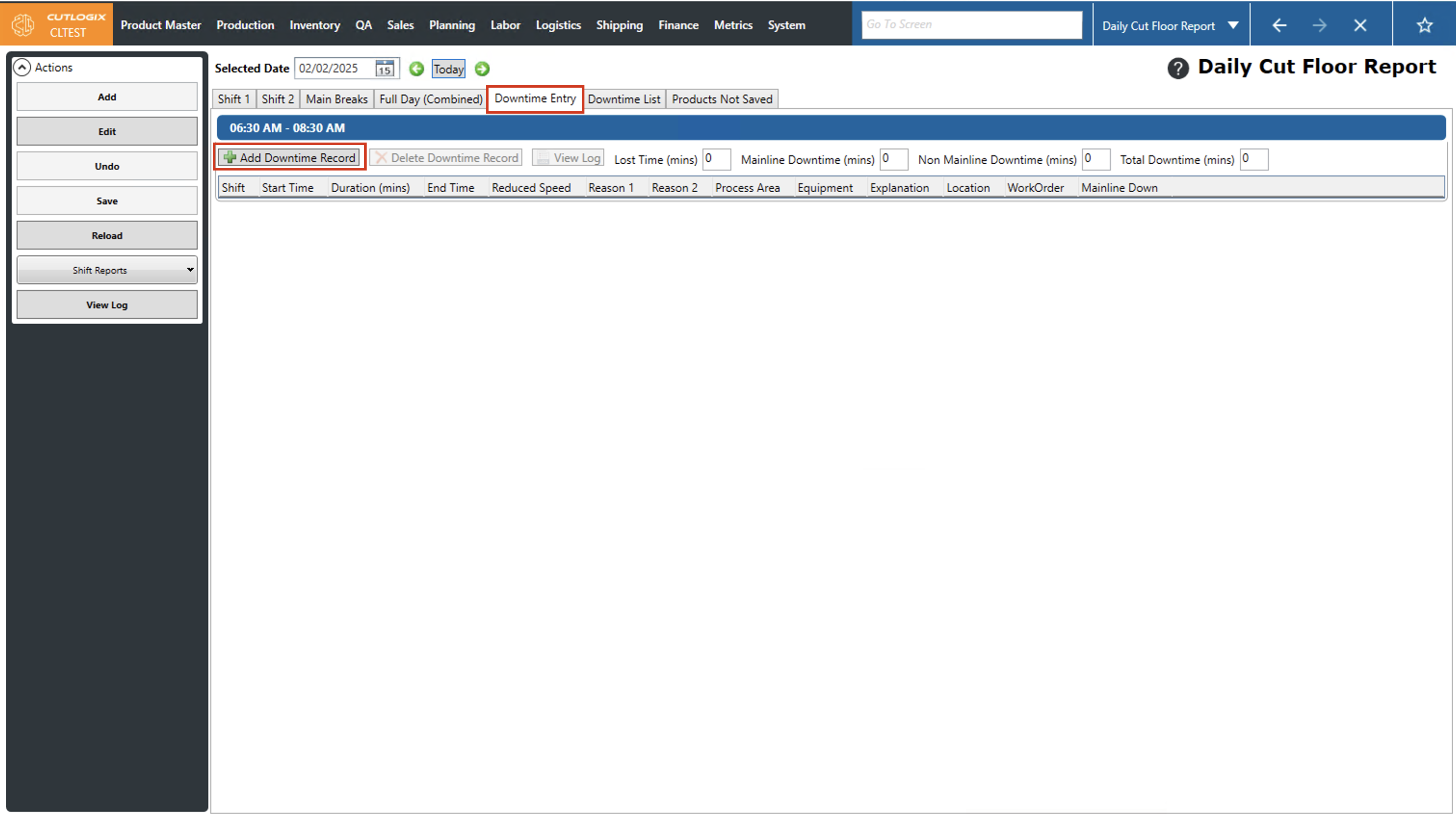
Step 2: Open the "Downtime Entry" tab, then click on the "Add Downtime Record" button.
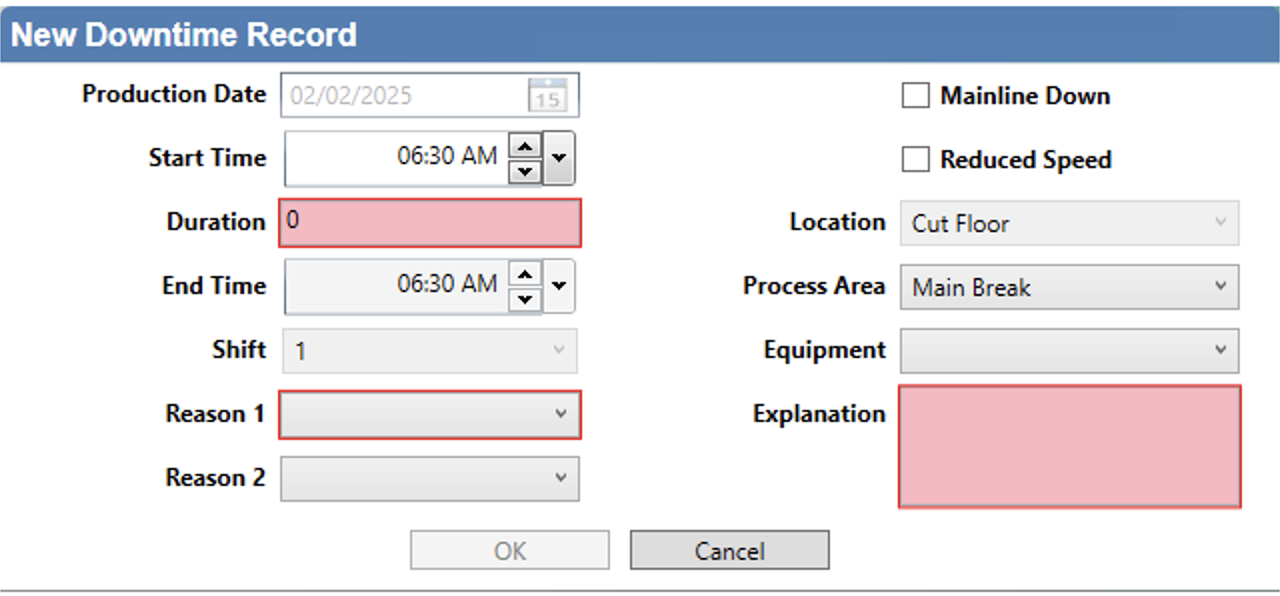
Step 3: A dialog will open, called "New Downtime Record." Here, you can enter information about the new downtime record. Fields highlighted in red are required and must be entered before the new downtime record can be saved. These fields are: Duration, Reason 1, Reason 2 and Explanation. Below is an explanation of all the fields on the dialog:
• Production Date: This is automatically set to the production date that the downtime record is being added to. This cannot be modified.
• Start Time: This is when the downtime began.
• Duration: The duration the downtime lasted in minutes.
• End Time: This is when the downtime began.
• Shift: This defaults to the shift section that the downtime record is being added from. This cannot be modified.
• Reason 1: The primary reason that downtime occurred. Users select this from the options in the dropdown.
• Reason 2: The primary reason that downtime occurred. Users select this from the options in the dropdown. This field becomes required after Reason 1 is added.
• Mainline Down: This checkbox indicates whether the issue that caused the downtime also caused the main production line to halt.
• Reduced Speed: This checkbox indicates whether the issue that caused the downtime caused the main production line to run at a reduced speed.
• Location: This defaults to "Cut Floor" and cannot be modified. This is because the downtime record was initially created from the Cut Floor report.
• Process Area: This will default to "Main Break" but can be modified if necessary by using the dropdown list.
• Equipment: If necessary, users can select the equipment that is down from the dropdown menu.
• Explanation: This provides a space for users to describe the reason that the downtime occurred.
• Production Date: This is automatically set to the production date that the downtime record is being added to. This cannot be modified.
• Start Time: This is when the downtime began.
• Duration: The duration the downtime lasted in minutes.
• End Time: This is when the downtime began.
• Shift: This defaults to the shift section that the downtime record is being added from. This cannot be modified.
• Reason 1: The primary reason that downtime occurred. Users select this from the options in the dropdown.
• Reason 2: The primary reason that downtime occurred. Users select this from the options in the dropdown. This field becomes required after Reason 1 is added.
• Mainline Down: This checkbox indicates whether the issue that caused the downtime also caused the main production line to halt.
• Reduced Speed: This checkbox indicates whether the issue that caused the downtime caused the main production line to run at a reduced speed.
• Location: This defaults to "Cut Floor" and cannot be modified. This is because the downtime record was initially created from the Cut Floor report.
• Process Area: This will default to "Main Break" but can be modified if necessary by using the dropdown list.
• Equipment: If necessary, users can select the equipment that is down from the dropdown menu.
• Explanation: This provides a space for users to describe the reason that the downtime occurred.
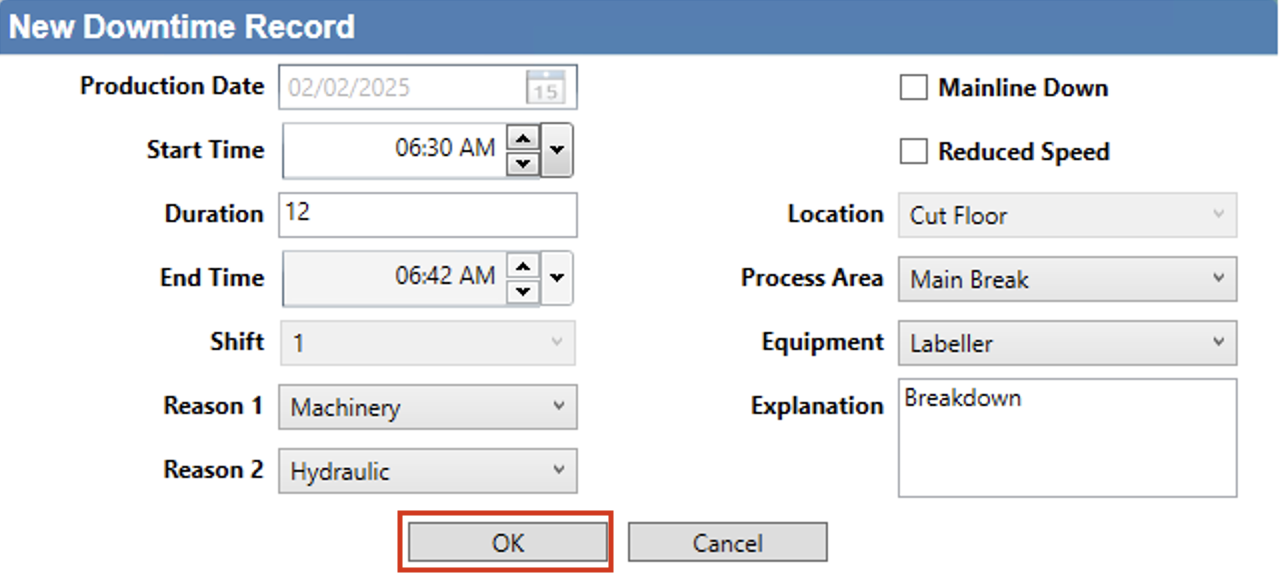
Step 4: Once all the required information has been added, click the "Ok" button to save the downtime record. If you don't want to save the downtime record, clicking "Cancel" will exit out of the dialog and any data entered will be discarded.
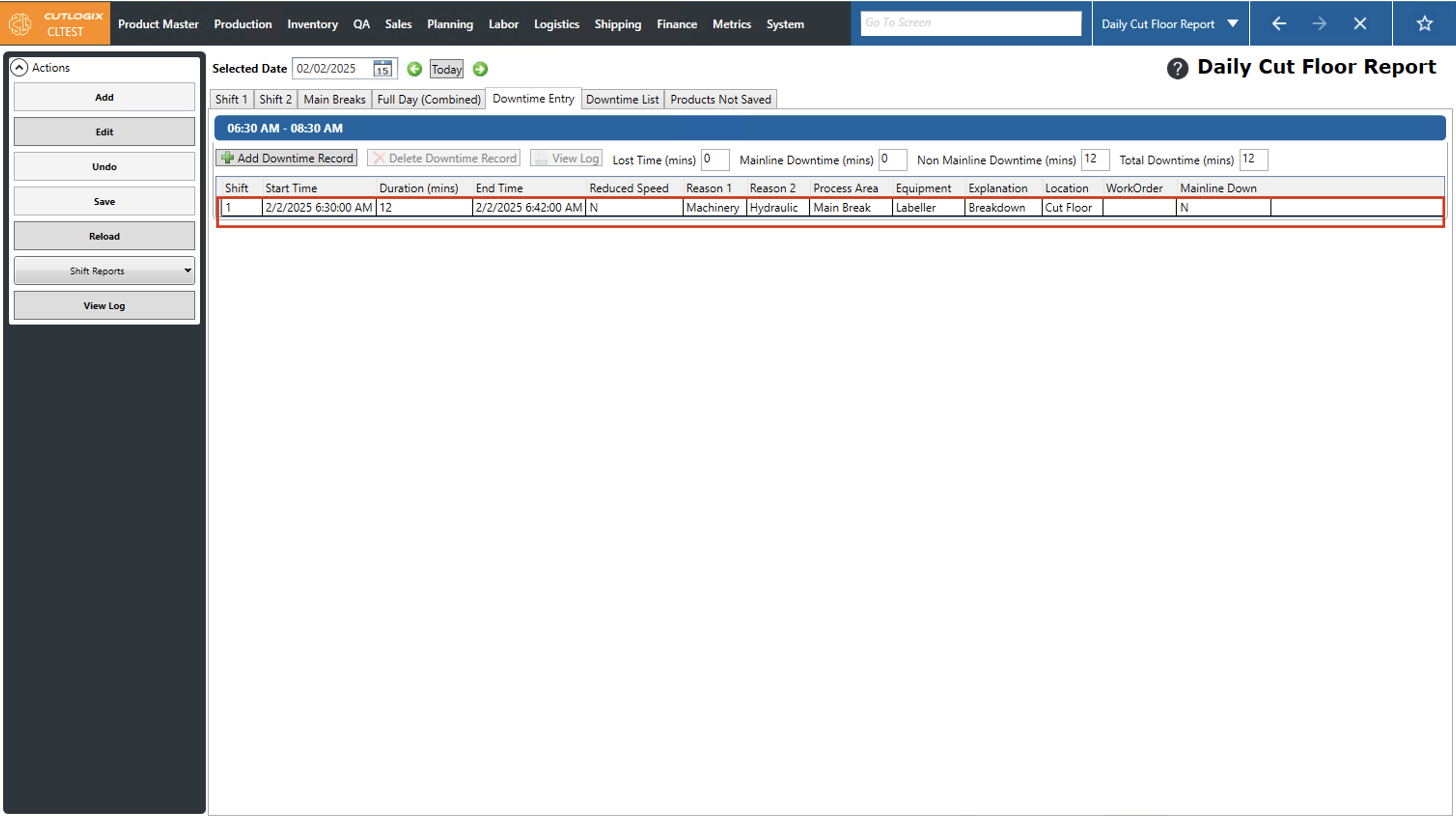
Step 5: After saving, the new downtime record will be added to the list of downtime records for the appropriate shift section (the one where it was added from), visible on both the "Downtime Entry" and the "Downtime List" tabs.
How to Edit Downtime Records
Demo
Step 1: To edit a downtime record, open the "Daily Cut Floor Report" page (Under the Production menu → Cut Floor → Daily Cut Floor Report) and choose the date that the downtime record you want to edit is on, then click on the "Downtime Entry" tab.
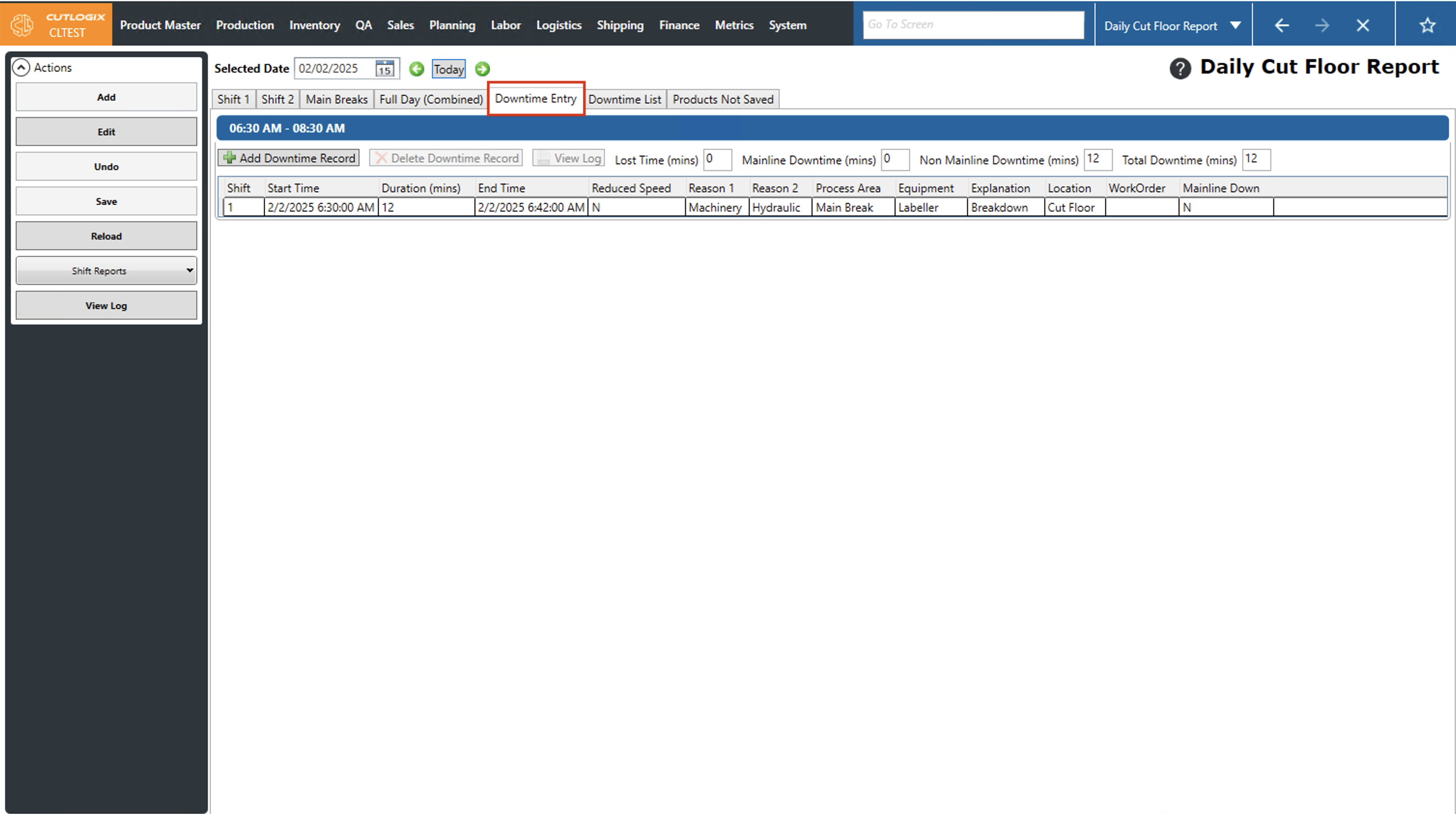
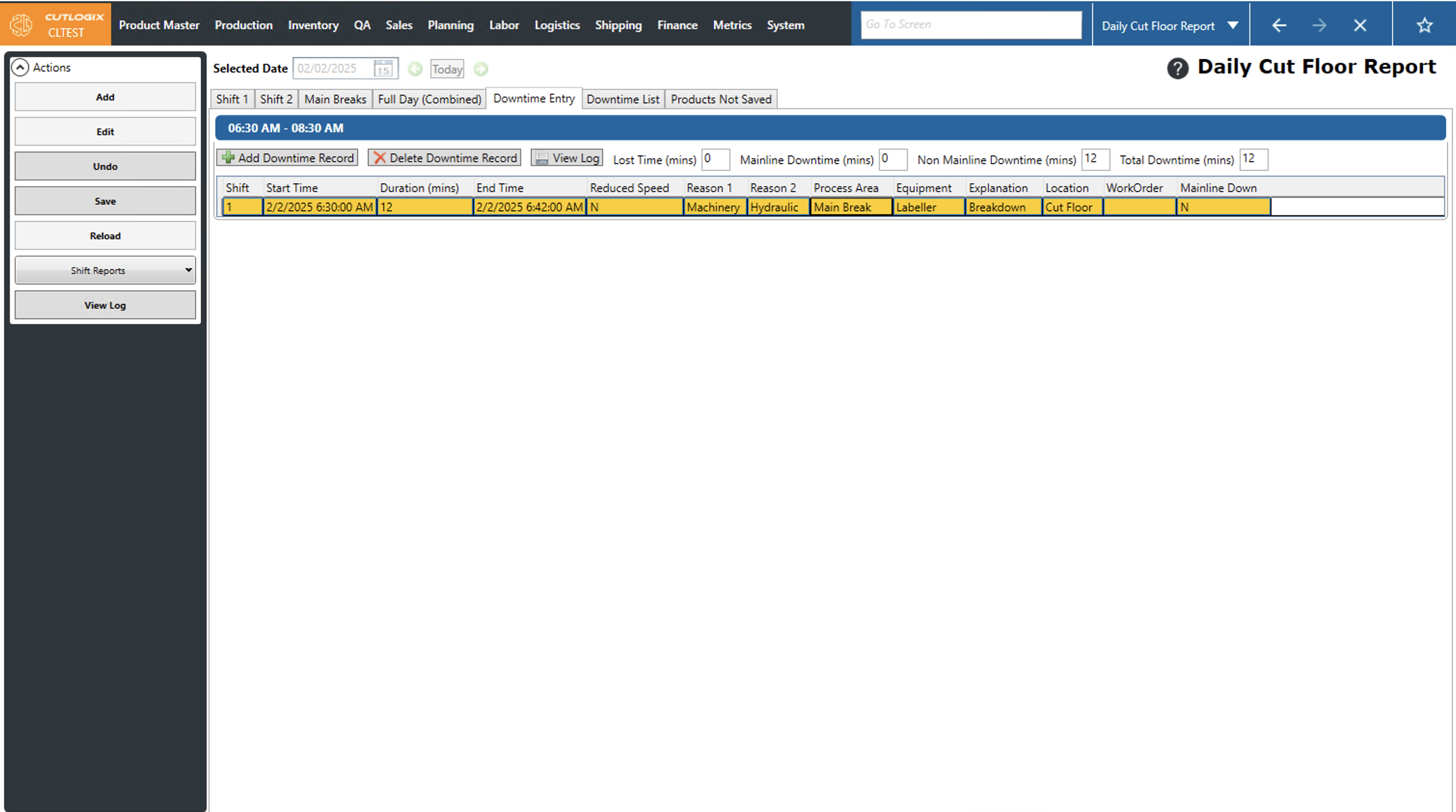
Step 2: Locate the downtime record that you want to edit (under the appropriate shift section) and double-click on it.
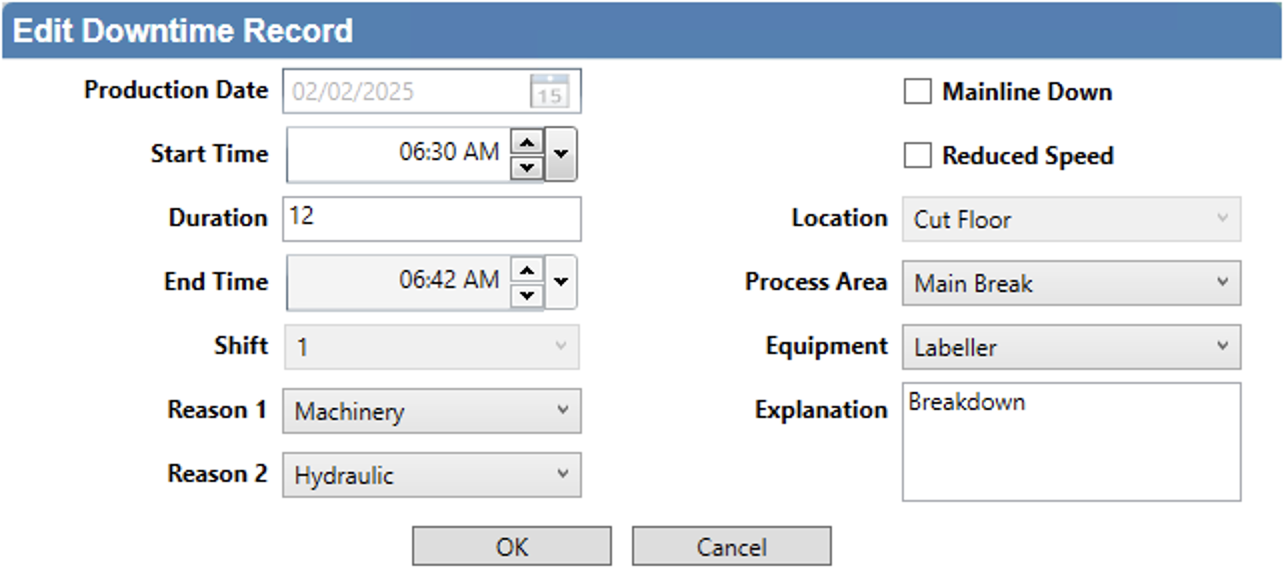
Step 3: The "Edit Downtime Record" dialog will open. Make any necessary changes to the downtime record, ensuring that all required fields are still filled out.
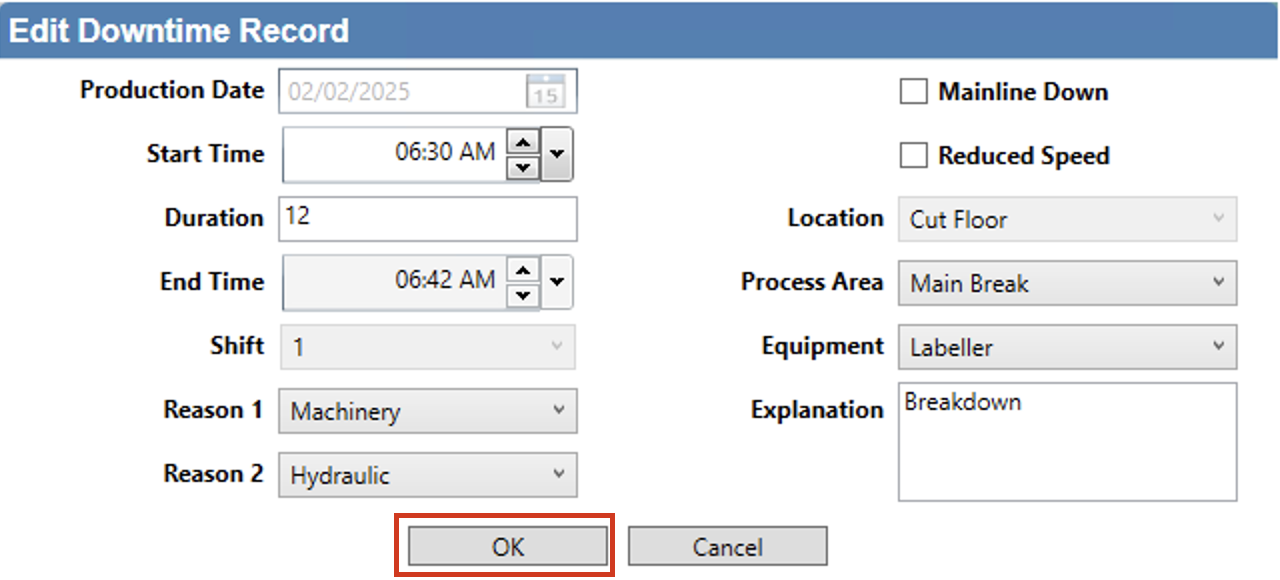
Step 4: Once all the changes have been made, click "OK" to save them, then they will be updated in the "Downtime Entry" tab as well as the "Downtime List" tab.
How to Delete Downtime Records
Demo
Step 1: Downtime records can be deleted from the same area that they are created. Open the "Daily Cut Floor Report" page (Under the Production menu → Cut Floor → Daily Cut Floor Report) and choose the date that the downtime record you want to delete is on, then click on the "Downtime Entry" tab.
Step 2: Locate the downtime record that you want to delete (under the appropriate shift section) and click on it. (It will now be highlighted in orange).
Step 3: Click the "Delete Downtime Record" button.
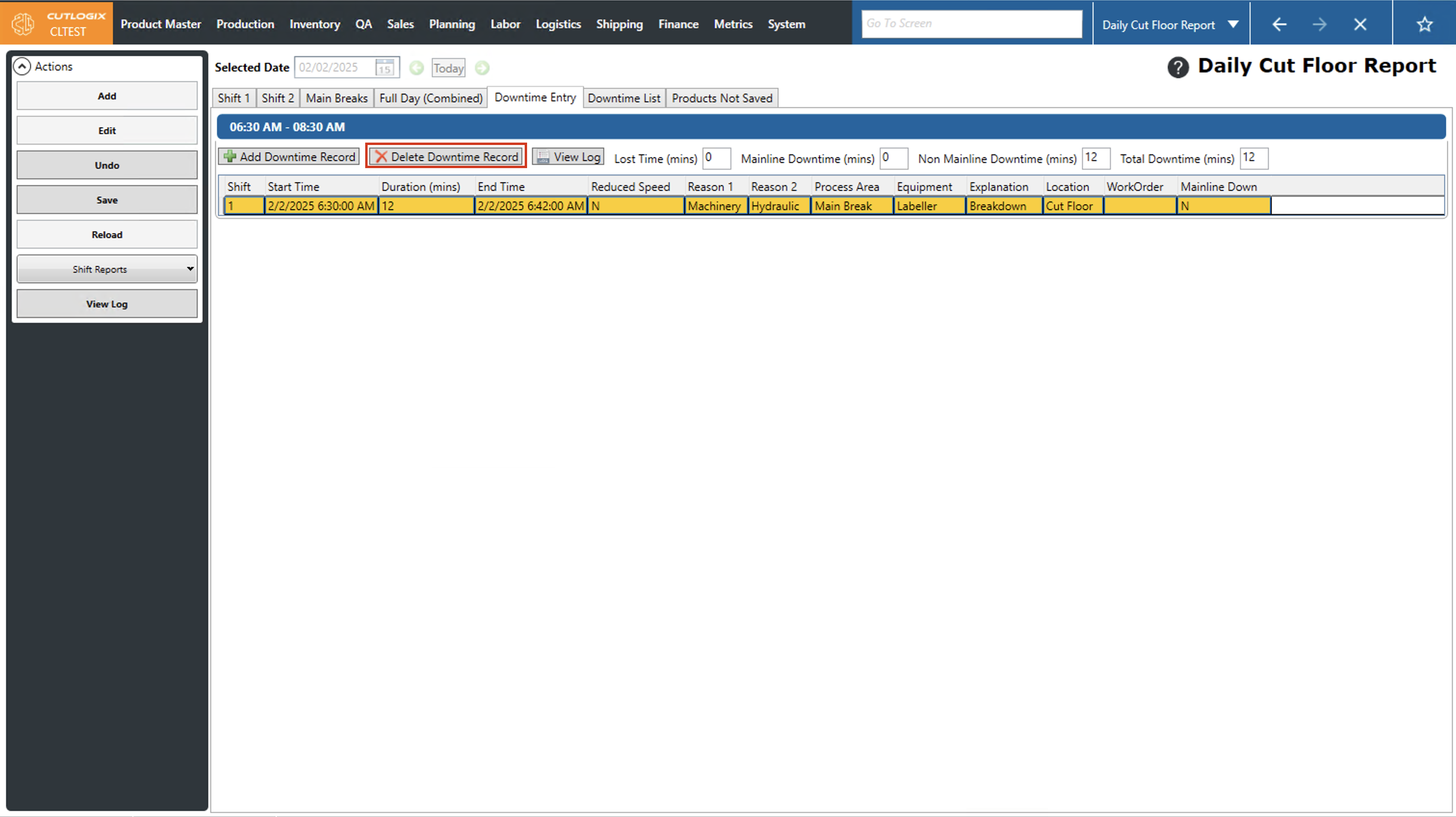
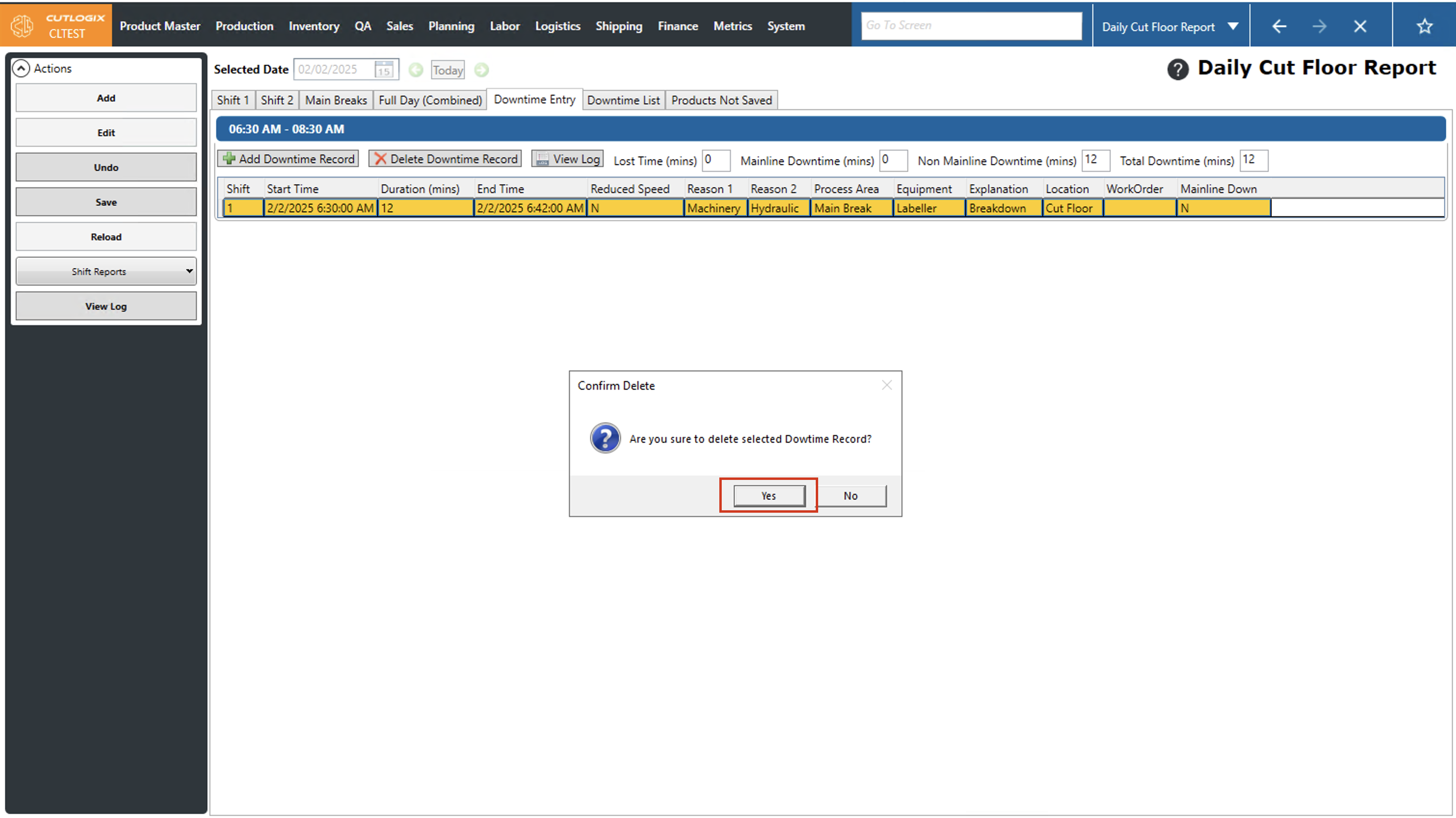
Step 4: A confirmation dialog will appear, asking if you're sure that you want to delete the downtime record. Click "Yes" to complete the deletion of the downtime record. (Note: Clicking no will close the dialog and the downtime record will remain unchanged) Once deleted the record will no longer appear in the list of downtime records.
How to View/Print the Daily Cut Floor Report
Demo
Step 1: Open the "Daily Cut Floor Report" page (Under the Production menu → Cut Floor → Daily Cut Report) for the date that you want to view the report for. Note that the selected date must have a daily cut floor report added to it in order to view the report.
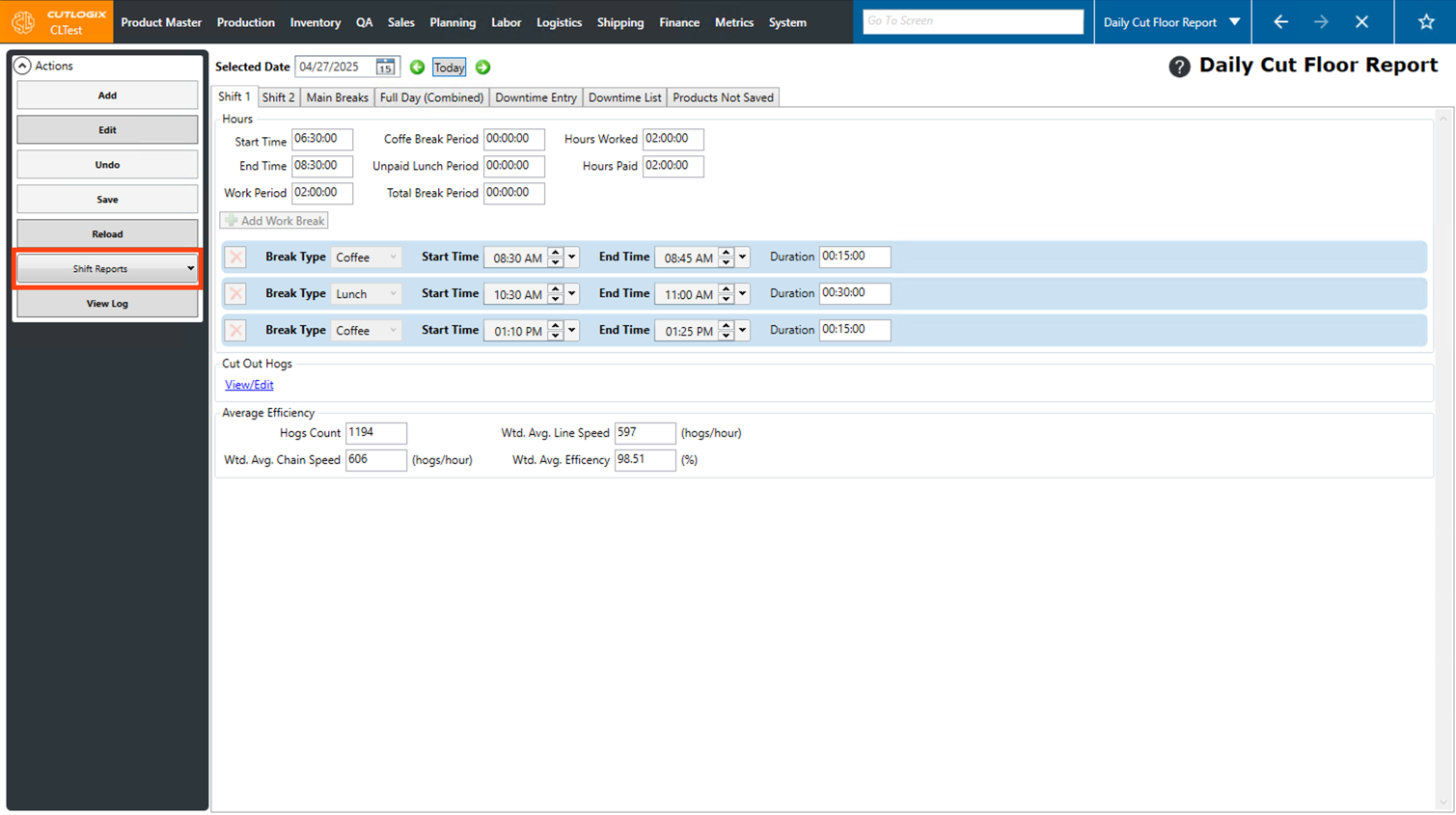
Step 2: Click on the "Shift Reports" dropdown list under the Actions Panel.
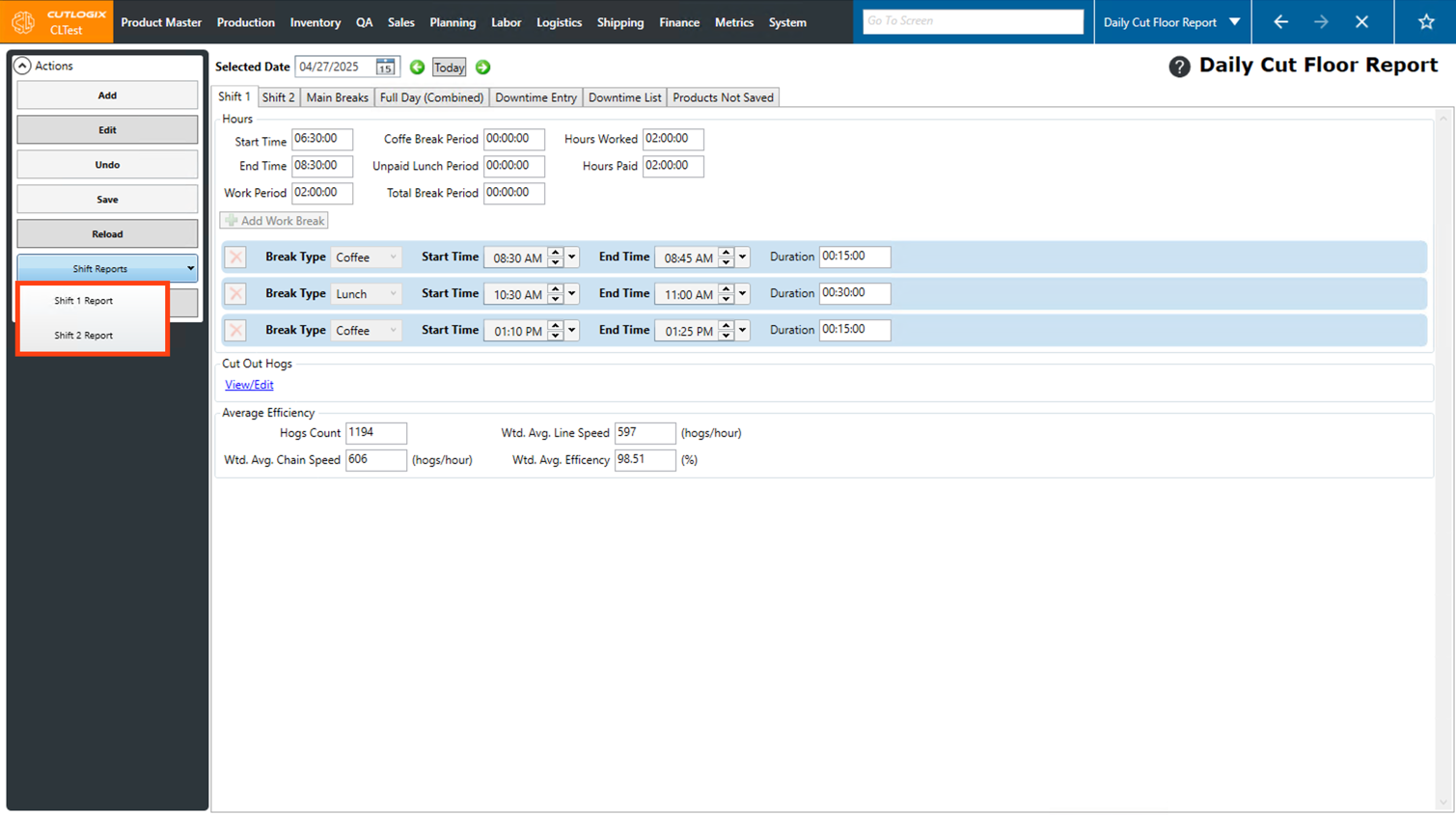
Step 3: In the list of reports that appear, click on the one that you'd like to view. There are 2 options, one for each shift.
Step 4: A dialog will appear, asking you where you'd like to save the file on your computer. At this point you can change the filename from the default to something else if you want to. Navigate to where you want the file to be saved, then click the "Save" button.
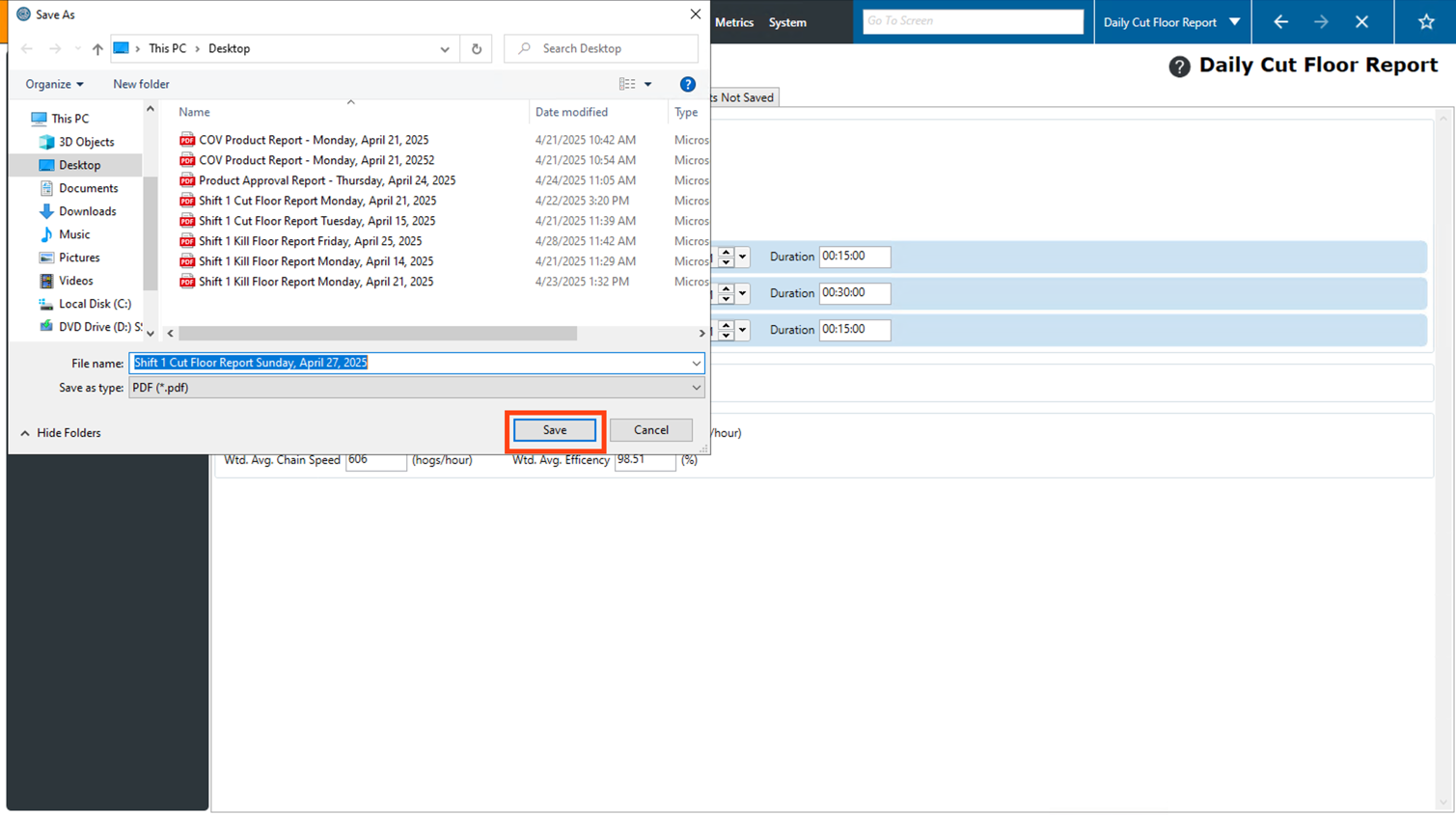
Step 5: The PDF report will then open in your default PDF viewer. If necessary you can also print the report from here. How to do this will vary depending on which PDF viewer you're using.